
Want Barcelona in one quick loop?
This tuk tuk route strings together some of Barcelona’s biggest hitters—Gaudí façades and Montjuïc panoramas—without making you plan a day around buses and zig-zagging streets. You get a guide, a small group, and lots of short stops that work like a moving city map: see it, understand it, then decide what deserves a longer visit.
I like two things most: first, you cover a lot of ground for $35.43 in about 1–2 hours, which is great when you’re short on time. Second, the guiding style can be very personal and practical; names like Pablo, Diane, and Carlos come up for being friendly, on-time, and good about turning viewpoints into useful stories and photo moments. One thing to keep in mind: this is mostly quick exterior stops and front-of-building views, so if you’re hoping for lots of time inside big ticket attractions, plan on buying entry separately.
In This Review
- Key Things That Make This Tuk Tuk Tour Worth Your Time
- The Real Goal: Get Your Bearings Fast
- Meeting Point in Eixample and How the Loop Ends
- From Eixample to Sagrada Familia: Modernism as a Story, Not a Checklist
- La Pedrera to Casa Batlló: Spot the Details You’ll See Later
- Arenas de Barcelona and the Shift Toward Montjuïc
- Montjuïc Stops: Medieval Echoes, Magic Fountain Timing, and Olympic Landmarks
- Museums, Funicular Views, and the Port That Powers the City
- Port Vell and Maremagnum: A Relaxing Finish with Real Options
- El Born, Picasso, MACBA, and Parc de la Ciutadella: Old Streets With Practical Context
- Price and Value: What $35.43 Buys You (and What It Doesn’t)
- Reliability, Ride Comfort, and Why Guide Choice Still Matters
- Who Should Book This Tuk Tuk Tour?
- Should You Book This Barcelona Tuk Tuk Tour?
- FAQ
- How long is the Barcelona Tuk Tuk Tour?
- Is the tour offered in English?
- What is included in the price?
- Do I need separate admission tickets for Sagrada Familia or Casa Milà?
- Are all stops free to enter?
- Where do I meet the tour, and where does it end?
- What group size should I expect?
- Are service animals allowed?
- Can I cancel for free?
Key Things That Make This Tuk Tuk Tour Worth Your Time
- Small group size (max 8) means more chances to ask questions instead of being herded.
- A fast-hit route links Eixample modernism, Montjuïc, and the harbor/old city in one session.
- Plenty of front-of-the-sight stops: Sagrada Familia, Casa Milà, Casa Batlló, Magic Fountain area, and more.
- Admissions are selective: some major sights require you to enter on your own time, not as part of the tour.
- You get water (1 bottle per person), which helps when you’re doing a concentrated sightseeing loop.
- English is offered, making it easier to follow the symbolism and “why it looks like that” explanations.
The Real Goal: Get Your Bearings Fast
This is the kind of tour that helps you understand Barcelona in layers. You start in Eixample and get modernism basics you can recognize later. Then you angle toward Montjuïc for views and landmarks tied to the city’s fairs and Olympics. After that, you shift down to the port and old streets—so the day ends with a sense of how neighborhoods connect.
The pacing is key. Even though the itinerary lists many stops, each one is short, usually built around photo time and a quick explanation. That’s not a flaw—it’s the whole point. If you’re trying to decide what to do for the rest of your trip, this loop acts like a high-speed preview.
Also, you’ll benefit from a practical setup: bottled water is included, and you’ll use a mobile ticket. The tour runs in English and is listed for participants who can handle a typical sightseeing ride and brief stops outdoors.
Torn between options? Line this one up against other Barcelona picks.

Meeting Point in Eixample and How the Loop Ends
You meet at Carrer de Casp, 8, L’Eixample, 08010 Barcelona. It’s a central start point, and the activity ends back at the meeting point, so you don’t have to figure out a new rendezvous location.
That back-to-start detail matters more than it sounds. Barcelona can be a maze when you’re tired or juggling metro lines, and returning to the same hub makes your evening plans easier. It also makes the tour a clean add-on to a pre-booked ticket day—like doing Gaudí exteriors first, then spending your paid entry time later where it counts.
From Eixample to Sagrada Familia: Modernism as a Story, Not a Checklist
One of the strengths here is that the route doesn’t treat architecture like a random photo contest. The guide frames what you see—symbolism on façades, and how Barcelona’s building styles changed over time.
You begin with a lesser-known Gaudí modernism stop, where the guide points out symbolic elements on the façade and sets it in its historical context. Then you glide along an iconic avenue, taking in mixed architectural styles and the way the streets evolved during the 20th century.
Next comes Plaza de Toros Monumental de Barcelona (exterior only). This is the last remaining bullring in Catalonia, and the guide explains its neo-Mudejar architecture plus the cultural role of bullfighting there. Even if you’re not a bullfighting fan, it’s useful because it widens your view of Catalan culture beyond Gaudí.
Then you reach L’Eixample District, where the guide ties the neighborhood’s grid to the ideas of urban planning (especially Ildefons Cerdà). If you’ve ever wondered why Eixample feels so orderly compared to older parts of the city, this is where the route gives you the why.
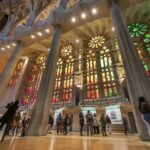
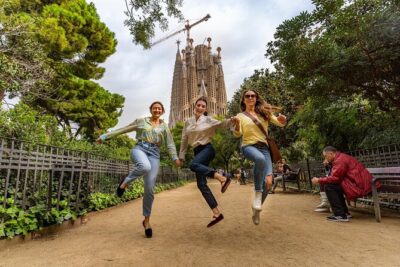
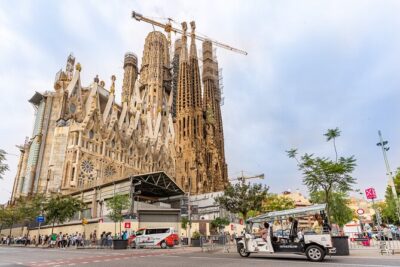
After that, you stop in front of Basilica de la Sagrada Familia. Tickets aren’t included, so it’s a look-from-the-street moment. Still, it’s a valuable stop because the guide points out architectural and symbolic details while you admire the imposing façade.
La Pedrera to Casa Batlló: Spot the Details You’ll See Later
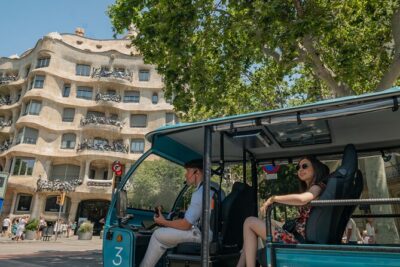
If you only know Gaudí from a couple iconic photos, this segment helps you start recognizing his design language. You’ll admire Casa Mila (La Pedrera), again exterior-focused with no admission included. The guide’s commentary is aimed at the innovations that show up in balcony shapes, chimneys, and the building’s undulating forms.
Then the tour shifts to a luxury avenue where the guide helps you connect nearby houses that share the modernist vibe but feel totally different. You’ll specifically stop for Casa Batlló, with myth and construction techniques woven into the explanation. Tickets aren’t included here either, so you’re really learning how to look—what to notice, and what to remember when you’re deciding whether to book entry later.
What I like about this approach is that it reduces the “scrolling past” feeling. You’re not just seeing famous buildings—you’re learning what to focus on when you revisit the areas later on foot.
Arenas de Barcelona and the Shift Toward Montjuïc
After the modernist highlights, you’ll see Arenas de Barcelona, a former square converted into a shopping center. The tour includes a stop for viewpoints, plus a restoration-and-new-use explanation. It’s a reminder that Barcelona reuses big structures instead of only replacing them.
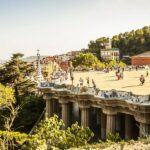
From there, the tour builds toward Montjuïc. You’ll make stops that act like milestones: a starting point for the area, the classical fountain in front of MNAC, and a pass by Europe’s largest fairgrounds (with commentary on its economic role).
These segments are especially useful if you’ve never been to Montjuïc. The hill can feel disconnected from the rest of the city when you’re there on your own. This tour gives you a sequence to follow, so the sights feel like a connected story instead of scattered postcards.
- Barcelona: Hola Barcelona Public Transport Travel Card★ 4.5 · 20,985 reviews
- Barcelona: 24 or 48-Hour Hop-On Hop-Off Bus Tour★ 4.4 · 20,872 reviews
- Barcelona: Park Guell Guided Tour with Skip The Line Entry★ 4.7 · 17,563 reviews
Montjuïc Stops: Medieval Echoes, Magic Fountain Timing, and Olympic Landmarks
Montjuïc is where the tour really turns into a “Barcelona in layers” experience.
You’ll stop to learn about the medieval Jewish cemetery of Montjuïc, which brings an often-overlooked part of the city’s past into view. Then there’s Magic Fountain of Montjuïc, where you’ll pause in front of the fountain and learn why it’s famous for light, music, and water shows. Since it runs on scheduled times, this stop is best if you can match your tour timing with the show schedule.
You’ll also explore views linked to cultural spaces: an innovative theater with commentary on its architecture and programming, plus an open-air theater inspired by ancient Greek theaters, overlooking the sea and used for festivals.
After that, you’ll see Lluís Companys Olympic Stadium from the exterior, with history spanning the 1929 through the 1992 Olympic Games. The tour continues with another modern facility tied to the Olympics and the role it plays in international events and concerts, plus a look at Olympic-sized pools and their Olympic/world championship use.
One more Montjuïc highlight: Poble Espanyol, an open-air architectural museum representing peoples and traditions from across Spain. It’s a change of pace from Gaudí and the sea views, and it can be a nice bridge if you’re craving something different after modernism and monuments.
Museums, Funicular Views, and the Port That Powers the City
Montjuïc isn’t only viewpoints and stadiums. The tour also includes art and movement.
You’ll stop at the Museu Nacional d’Art de Catalunya (MNAC) lobby, where the guide explains the collection of Romanesque and Gothic art. Entry isn’t included, so again, it’s a first look, not a full museum visit.
Then there’s a stop connected to a Joan Miró foundation, with a brief orientation about his work and impact on modern art (as presented on the stop). This is a helpful “taste” if you want to go deeper later.
To move comfortably up and down, the tour includes a funicular ascent. Even if you don’t care about the technical piece, it makes the day more efficient and gives you views without adding extra stair climbs.
Then you shift to the city’s economic engine: Puerto de Barcelona. You’ll hear why the port matters and see it from viewpoints. The tour also includes a walk with Mediterranean flora from around the world, with conservation and biodiversity explained as you go. You’ll pass by the modern waterfront office and conference complex too, which helps connect Barcelona’s skyline to how the city runs today.
Port Vell and Maremagnum: A Relaxing Finish with Real Options
After the broader city storytelling, the tour softens into waterfront energy.
You’ll stroll through Port Vell (Old Port), now renovated and filled with shops and luxury yachts, with a historical account of the transformation. Then you’ll get time for Maremagnum, where you can wander, grab a snack, and enjoy terrace views. This is one of the spots that can turn a fast tour into a comfortable end to your afternoon.
Even the “symbol” stop is part of that shift: the guide points out the symbolism of a 60-meter-high column connected to the discovery of America. It’s short, but it helps you understand what you’re looking at when you spot it from other streets later.
El Born, Picasso, MACBA, and Parc de la Ciutadella: Old Streets With Practical Context
Toward the later part of the loop, you’ll step into areas that feel more like real neighborhoods than “attractions.”
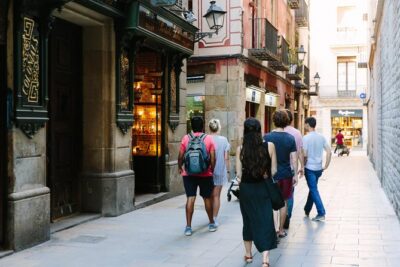
You’ll walk through medieval alleys, hidden squares, and Roman remains, with the guide explaining parts of ancient Barcelona. Then you’ll pause in the El Born area, tied to cultural landmarks like the Picasso Museum and the ancient archaeological market. The tour keeps pushing this theme of social change and cultural identity.
You’ll also get a look at the MACBA area from the outside, which is useful even if you don’t go inside. The route frames how the neighborhood shaped itself as a multicultural space.
Then comes La Rambla, where you’ll see street performers and flower stalls. You’ll also get safety warnings, which is smart on a crowded street where pickpocket risk exists. I like when a tour doesn’t just point out what to photograph, but also helps you stay sharp.
From there, you head to Parc de la Ciutadella, where you enter the park and enjoy the monumental fountain, lake, and relaxed atmosphere. It’s a good breather after dense streets.
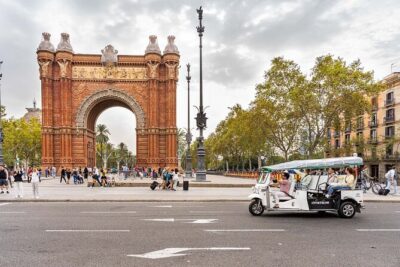
Finally, you stop at Arco di Trionfo, a neo-Mudejar arch connected to the 1888 World’s Fair. It’s one of those photo-friendly monuments that also gives you a quick lesson in Barcelona’s fair history.
Price and Value: What $35.43 Buys You (and What It Doesn’t)
At $35.43 per person (about 1–2 hours), you’re paying for transport plus interpretation. The value is not in ticketed museum time. Many major stops are not included—including the Sagrada Familia, Casa Milà, MNAC, and Plaza de Toros. Some other stops are listed as free admission, which helps your budget.
So here’s the trade-off in plain language: this tour is best if you want a guided “map + meaning” of Barcelona fast. If you’re the type who wants to spend long hours inside famous places, you’ll still want to book those separately.
In that sense, the tour shines as a first-day strategy. You finish with a clear sense of where you want to return—and which sights deserve your time and money.
Reliability, Ride Comfort, and Why Guide Choice Still Matters
A couple practical notes based on the information you’ve been given.
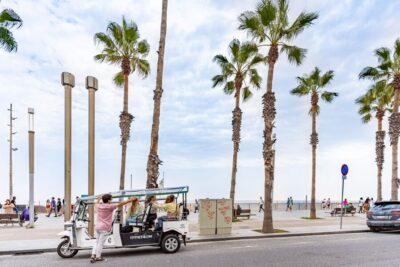
The ride uses tuk tuk vehicles that are described as open-sided and designed for maximum visibility, so you’re meant to have a decent view without climbing around. That said, a few comments mention the ride can feel bumpy, so if you’re sensitive to rough pavement or you get motion uncomfortable, consider that.
Guide quality also seems to influence how satisfying the commentary feels. Names like Pablo, Diane, and Carlos show up positively for knowledge and friendliness, with attention to picture time and respectful, on-time service. Even with the same route, the human touch can change your experience from “nice ride” to “useful city education.”
Who Should Book This Tuk Tuk Tour?
This is a strong fit if:
- You’re seeing Barcelona for the first time and want a quick orientation.
- You want to connect Gaudí modernism with Montjuïc, the port, and old streets in one outing.
- You don’t want to do multiple taxis or route-planning on your own.
- You prefer short stops and guided explanation over long museum sessions.
It might not be ideal if:
- You want long indoor visits at major sights (Sagrada Familia, MNAC, Casa Milà).
- You dislike fast pacing and prefer deep, slow walking tours instead.
- You’re very sensitive to ride comfort.
Should You Book This Barcelona Tuk Tuk Tour?
Yes, if you want a high-coverage introduction that helps you decide what to do next. It’s especially useful for a short stay because it connects neighborhoods that normally take time to reach and understand.
Before you book, match your expectations to the format: it’s a quick overview, not a ticketed “museum day.” If you treat it like a guided preview—then follow up with deeper visits—you’ll get a lot out of the time you spend.
If you’re booking during fountain show hours, aim for timing that lets you catch the Magic Fountain stop when it’s operating. And if you’re picky about views, don’t be shy about asking the guide where you should sit so you can see comfortably during stops.
FAQ
How long is the Barcelona Tuk Tuk Tour?
The duration is listed as approximately 1 to 2 hours.
Is the tour offered in English?
Yes, it’s offered in English.
What is included in the price?
Bottled water is included (1 bottle of water per person), and you’ll use a mobile ticket.
Do I need separate admission tickets for Sagrada Familia or Casa Milà?
Yes. Admission tickets are not included for stops like Sagrada Familia and Casa Milà (La Pedrera).
Are all stops free to enter?
No. Some stops are listed as free (for example, parts of L’Eixample and Arenas de Barcelona viewing), while others require admission tickets not included.
Where do I meet the tour, and where does it end?
You meet at Carrer de Casp, 8, L’Eixample, 08010 Barcelona, Spain, and the tour ends back at the meeting point.
What group size should I expect?
The tour has a maximum of 8 travelers.
Are service animals allowed?
Yes, service animals are allowed.
Can I cancel for free?
Yes. Free cancellation is available if you cancel at least 24 hours in advance for a full refund.
More Ways to Tour Barcelona
- Barcelona: Casa Batlló Entry with Self-Audioguide Tour
★ 4.7 · 25,359 reviews - Barcelona: 24 or 48-Hour Hop-On Hop-Off Bus Tour
★ 4.4 · 20,872 reviews - Barcelona: Park Guell Guided Tour with Skip The Line Entry
★ 4.7 · 17,563 reviews - Barcelona: Sagrada Familia Skip-the-Line Entry Ticket & Tour
★ 4.8 · 12,789 reviews - Barcelona: FC Barcelona Museum “Barça Immersive Tour” Ticket
★ 4.4 · 10,944 reviews
More Barcelona Tours on Our Radar
- Barcelona: Sagrada Familia Entry Ticket with Audio Guide
★ 4.6 · 105,312 reviews - Barcelona: Park Güell Admission Ticket
★ 4.4 · 76,534 reviews - Barcelona: Casa Batlló Entry with Self-Audioguide Tour
★ 4.7 · 25,359 reviews - Barcelona: Montjuïc Cable Car Roundtrip Ticket
★ 4.5 · 22,368 reviews - Barcelona: Hola Barcelona Public Transport Travel Card
★ 4.5 · 20,985 reviews
Just Rated Around Barcelona




Tuk-Tuks, compared.
 ★ 5.0Tour Welcome Barcelona with Local Guide in Eco Tuk Tuk PrivateFrom $281,882 reviews
 ★ 4.9Private City Tour by Eco Tuk TukFrom $331,339 reviews
 ★ 5.0Barcelona Expert Tour with Local Guide in Eco Tuk Tuk PrivateFrom $28216 reviews
 ★ 4.9City Highlights Private Tuk-Tuk TourFrom $37161 reviews
 ★ 5.0Barcelona 2 Hours Private Tuk-Tuk TourFrom $5338 reviews
 ★ 4.81,5-Hour Barcelona City & Beach Private Tuk-Tuk TourFrom $5637 reviews
 ★ 4.4Private Christmas Lights Tour by Eco Tuk TukFrom $4735 reviews
 ★ 4.5Barcelona Express Tour in a Private Eco Tuk TukFrom $5229 reviews
Browse the lists this tour appears in