

Reviewed · GOTHIC QUARTER TOURS
Barcelona Historical Walking Tour: Gothic Quarter and El Born
Barcelona’s Old Town is a maze with a brain. This walk turns the Gothic Quarter and El Born into an easy timeline, from artist hangouts to Roman leftovers and Catalan traditions you can actually point at. I love the way the route stays walkable and not rushed, and I also like how the guide stories make the stone feel specific, not generic. One drawback: two church stops have admission not included, so you’ll decide on the fly whether you want to pay to go in.
What makes it especially good value is the focus on details you’d miss if you only ride buses. It’s a small group (max 20), in English, and you end right where your feet will appreciate a proper finish: Santa Maria del Mar. If you’re trying to cram Barcelona into one quick morning, this is a smart use of time.
In This Review
- Key highlights to look for
- Gothic Quarter to El Born: a 2-hour shortcut to Barcelona’s oldest streets
- From Els 4 Gats to Pont del Bisbe: artist myths, legends, and the feel of the lanes
- Roman leftovers at Casa de l’Ardiaca, plus Eulàlia at Catedral
- Placa Sant Felip Neri to MUHBA – El Call: how war scars and minority stories share the same streets
- Placa de Sant Jaume and Plaça del Rei: government power and the dark side of charm
- Plaça de l’Àngel to Santa Maria del Mar: grain trading, a legend, and a strong finish
- Price and logistics: what $30.25 buys you in real terms
- Who should book this walk (and who might want a different plan)
- Should you book it?
- FAQ
- How long is the Barcelona Historical Walking Tour?
- What is the price per person?
- Where does the tour start and end?
- Is the tour offered in English?
- What’s included in the tour?
- Are admission tickets included for all stops?
- How big is the group?
- Is there a mobile ticket?
- Can I cancel for a full refund?
Key highlights to look for
- Small group pacing that gives you time to spot details and take photos without sprinting
- Artist + politics storylines that connect Picasso, Gaudí, and La Diada to the exact corners you see
- Roman traces in plain sight (including a vertical Roman wall face and aqueduct bits)
- Legends baked into architecture, like the superstition tied to Pont del Bisbe
- El Call streets and MUHBA bringing Jewish Barcelona into the same walking loop
- Two notable add-on interiors (Catedral and Santa Maria del Mar) if you want to go in
Gothic Quarter to El Born: a 2-hour shortcut to Barcelona’s oldest streets
This is the kind of tour that helps you get your bearings fast. You start in Ciutat Vella, then move through the Gothic Quarter’s tight lanes and squares, and finally finish in El Born near the sea-minded calm of Santa Maria del Mar. Bus tours can hit the big postcards; this one gets you into the walkable sections where you can actually feel how the city used to work.
The timing is about 2 hours, with frequent short stops. Think of each segment as a story plus a location, not a long lecture. In practice, that means you’re always looking at something—like a doorway, a plaque, a bridge, or a square corner—and the guide explains why it matters.
If you’re the type who likes to understand what you’re staring at, you’ll appreciate how the tour mixes art, religion, war memory, and everyday trade. It’s not just old buildings; it’s old reasons.
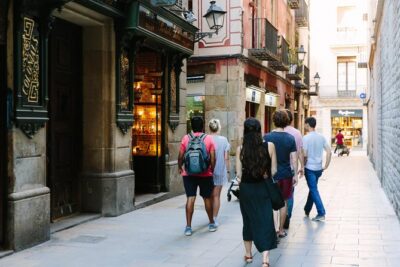
Deeper into the lanes of the Barri Gòtic


From Els 4 Gats to Pont del Bisbe: artist myths, legends, and the feel of the lanes
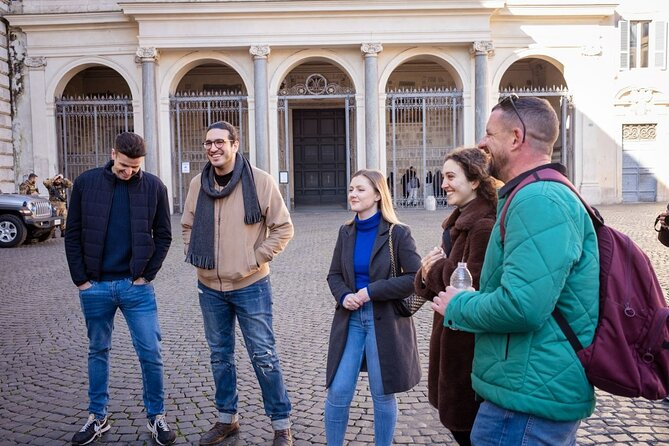
The walk begins at Plaça del Vuit de Març and opens with Els 4 Gats, the historic café/restaurant tied to Barcelona’s modernist and intellectual scene. This is where you hear how Picasso and Gaudí were part of the same cultural orbit—different styles, same city pulse. The Art Nouveau vibe helps you understand why Barcelona’s creativity didn’t stay in galleries; it lived in cafés and conversations.
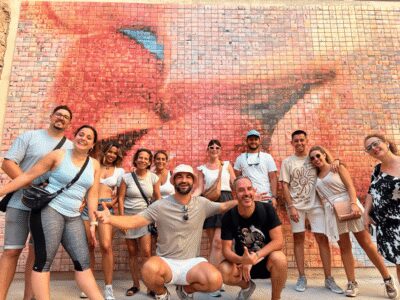
Then you’ll head toward El Mon Neix En Cada Besada, a photomosaic erected in 2014 linked to the Catalan defeat of September 11, 1714 during the War of Spanish Succession. The guide connects the event to modern-day commemoration—La Diada—so the point isn’t just the artwork. It’s the idea of how historical trauma turns into yearly identity and public meaning. Even if you’re not deep into Spanish history, this stop gives you a clear thread to follow later.
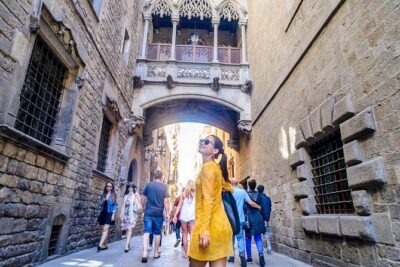
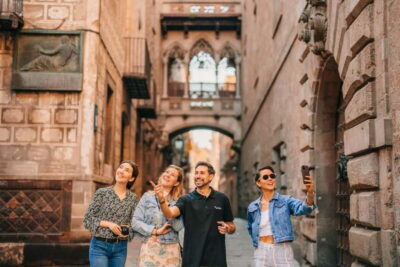
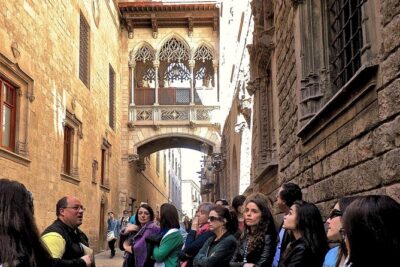
Next comes the Roman-to-Gothic layering. You’ll stop at Pont del Bisbe on Carrer de Bisbe. It’s a Neo-Gothic bridge that looks like it belongs in a storybook, but what really hooks you is the superstition behind it. After you hear the legend, you’ll look at the bridge like it has a second set of lines—this is exactly the kind of “why does that matter” detail that makes the whole quarter come alive.
Along the way, you’ll keep noticing how the streets feel built for walking. The turns are tight. The sightlines are short. It’s the opposite of “look, then move on.” You actually slow down, then speed up again when the guide turns the corner with a new explanation.
Roman leftovers at Casa de l’Ardiaca, plus Eulàlia at Catedral
One of my favorite moments here is Casa de l’Ardiaca, tucked into the Gothic Quarter and known for a mix of Gothic and Renaissance elements. The standout is what it houses: a vertical face of a Roman wall plus aqueduct remains. You don’t need a museum ticket to understand the point. The location itself is proof that Barcelona kept reusing (and sometimes re-covering) older layers instead of wiping everything clean.
This stop is also a good reset after the modern stories. It’s a reminder that Barcelona doesn’t switch eras at convenient points. Roman, medieval, and later identity overlap, sometimes in the same structure.
Then you’ll reach Catedral de Barcelona, a Gothic-style church tied to the life and death of Saint Eulàlia, whose story includes torture under Roman rule. The key practical note: admission isn’t included for this stop. That’s not a problem; it just means you can choose what matters to you. If you want the full interior experience, you’ll pay on your terms. If you’re focused on exterior context and moving through the streets, you can still get the essentials from what you see outside.
Placa Sant Felip Neri to MUHBA – El Call: how war scars and minority stories share the same streets
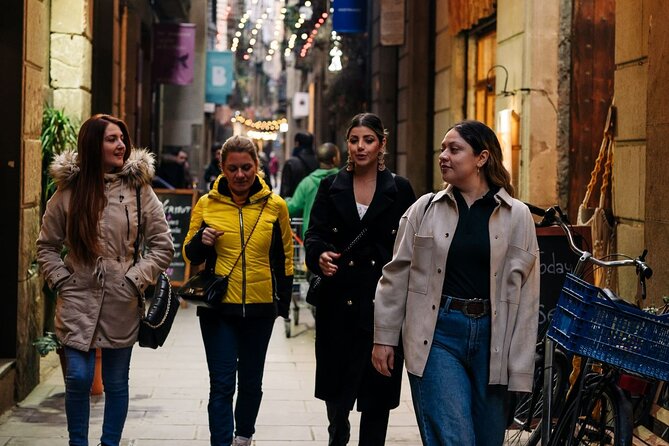
Not every stop here is cheerful, and that’s the point. Plaça Sant Felip Neri is a small square, but it carries sombre Spanish Civil War history. The “scars” theme isn’t just poetic. The guide’s explanation makes you read the space like a record—an urban surface that remembers what happened there.
From there, the tour turns into one of the most meaningful historical sections: MUHBA – El Call. This is Barcelona’s Jewish quarter, and the value is in the combination of narrow streets and medieval layout. You’ll hear about the synagogue area and local legends tied to this neighborhood. Even if you only get a short look, the stop helps you understand that El Call wasn’t an add-on chapter; it shaped the city’s daily life and architecture.
A practical tip: wear shoes you don’t mind getting a little close-up. El Call lanes are narrow, and if you’re trying to photograph without blocking others, you’ll want to step aside quickly.
Placa de Sant Jaume and Plaça del Rei: government power and the dark side of charm
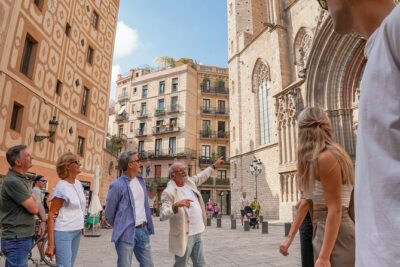
After El Call, the walking energy shifts to the city’s official centers. Plaça de Sant Jaume is the hub of government activity, wrapped by historical buildings. This stop helps you see the Gothic Quarter as more than a tourist set—it’s where civic life and authority meet stone and ceremony.
A bit later, Plaça Del Rei brings you to a space associated with the Royal Palace. It can look peaceful in photos, but the guide’s storytelling highlights the darker edges underneath. That contrast is useful. Barcelona often does this: pretty facades with power and danger in the background.
If you’re building an itinerary for later, these stops are where you’ll start making sense of where to head next. You now know which plazas feel ceremonial, which feel political, and which feel like neighborhood life.
More Barcelona streets to take slowly
- Barcelona Tapas and Wine Experience Small-Group Walking Tour★ 5.0 · 5,804 reviews
- Barcelona: Tapas Walking Tour with Food, Wine, and History★ 4.8 · 4,261 reviews
- Barcelona: Food Walking Tour with Tapas and Wine★ 4.9 · 2,180 reviews
Plaça de l’Àngel to Santa Maria del Mar: grain trading, a legend, and a strong finish
The tour ends with the kind of stop that makes your legs feel rewarded. Plaça de l’Àngel was once Wheat Square, a major grain trading hub. You’ll also hear a heavenly legend tied to the square’s name—the guide explains how that word choice grew out of local storytelling. It’s a nice way to end on something that’s part economics, part folklore.
Then you finish at Basilica de Santa Maria del Mar. This is Catalan Gothic, and it’s strongly connected to the city’s maritime world. Again, admission isn’t included, so you can decide whether you want to pay to go inside or simply take in the exterior and the atmosphere.
Either way, arriving here after the dense Gothic streets feels like stepping out of a narrow thought bubble into a wider space. It gives your day an ending that doesn’t feel rushed.
Price and logistics: what $30.25 buys you in real terms
At $30.25 per person for about 2 hours, this tour sits in the value sweet spot for Barcelona’s Old Town. You’re paying for three things: a guided thread through a complicated area, help noticing what matters, and a pacing strategy that’s small-group friendly.
A few practical details that make the experience smoother:
- The group is capped at 20 people, which helps you hear the guide and keeps the walking manageable.
- It runs in English, and you get a mobile ticket.
- Confirmation happens at booking time, and the meeting point is clearly set in Ciutat Vella.
Also, the guide style varies by person, but what stays consistent is the tour format. Some guides use tools like an iPad to show historical context, which helps when buildings look similar from the street. Others bring humor to keep the kids engaged, and many offer food and drink suggestions afterward—so the tour doesn’t just end when it ends.
One thing to consider: two key churches require admission not included. That doesn’t mean skip them; it just means you should mentally budget for optional entries if you’re the sort who wants to see interiors.
Who should book this walk (and who might want a different plan)
I think this tour is best for you if:
- You want a focused intro to the Gothic Quarter + El Born without getting lost
- You like stories that connect art, politics, and daily life to specific streets
- You prefer a pace that lets you pause, look, and take photos
- You’re traveling with teenagers or kids who still need some entertainment mixed in
You might choose something else if:
- You’re only interested in one giant attraction and don’t want multiple smaller stops
- You strongly prefer tours that spend most time inside buildings (since a couple interiors are optional with admission)
And if you can pick your time of day: going earlier often feels easier. The Old Town is cooler and less chaotic, so the walking feels more relaxed.
Should you book it?

Yes—if you want a strong start in Barcelona’s oldest streets, this is an easy yes. The price is fair for a two-hour, small-group walk that explains what you’re actually seeing: artist cafés, Roman traces, war memory, Jewish quarter streets, and the civic squares in between.
The only real decision point is whether you plan to pay for interior access at Catedral de Barcelona and Santa Maria del Mar. If you’re open to optional entries, you’ll get the full payoff.
If you want a short, smart morning plan that helps the rest of your trip click into place, book it and wear shoes for tight medieval lanes.
FAQ
How long is the Barcelona Historical Walking Tour?
It lasts about 2 hours.
What is the price per person?
The price is $30.25 per person.
Where does the tour start and end?
It starts at Plaça del Vuit de Març, Ciutat Vella, 08002 Barcelona and ends at Basílica de Santa Maria del Mar, Plaça de Santa Maria, 1, Ciutat Vella, 08003 Barcelona.
Is the tour offered in English?
Yes, it is offered in English.
What’s included in the tour?
It includes a guided walking tour with a local tour guide, plus city highlights and hidden gems.
Are admission tickets included for all stops?
No. Catedral de Barcelona and Basilica de Santa Maria del Mar list admission as not included. The other stops in the route are listed as free.
How big is the group?
The tour has a maximum of 20 travelers.
Is there a mobile ticket?
Yes, you get a mobile ticket.
Can I cancel for a full refund?
You can cancel for a full refund if you cancel at least 24 hours before the experience’s start time.
More Ways to Tour Barcelona
- Barcelona: Casa Batlló Entry with Self-Audioguide Tour
★ 4.7 · 25,359 reviews - Barcelona: 24 or 48-Hour Hop-On Hop-Off Bus Tour
★ 4.4 · 20,872 reviews - Barcelona: Park Guell Guided Tour with Skip The Line Entry
★ 4.7 · 17,563 reviews - Barcelona: Sagrada Familia Skip-the-Line Entry Ticket & Tour
★ 4.8 · 12,789 reviews - Barcelona: FC Barcelona Museum “Barça Immersive Tour” Ticket
★ 4.4 · 10,944 reviews
More Barcelona Tours on Our Radar
- Barcelona: Sagrada Familia Entry Ticket with Audio Guide
★ 4.6 · 105,312 reviews - Barcelona: Park Güell Admission Ticket
★ 4.4 · 76,534 reviews - Barcelona: Casa Batlló Entry with Self-Audioguide Tour
★ 4.7 · 25,359 reviews - Barcelona: Montjuïc Cable Car Roundtrip Ticket
★ 4.5 · 22,368 reviews - Barcelona: Hola Barcelona Public Transport Travel Card
★ 4.5 · 20,985 reviews
Lost in the Gothic Quarter
- Barcelona in 1 Day: Sagrada Familia, Park Guell,Old Town & Pickup
★ 5.0 · 13,541 reviews - Barcelona all included: Sagrada, Park Güell, Montjuic & Gothic
★ 5.0 · 2,169 reviews - Barcelona: Sagrada Familia, Modernism, and Old Town Tour
★ 4.7 · 1,621 reviews - Barcelona Gothic Quarter Tapas & Taverns Food & Wine Tour
★ 5.0 · 1,470 reviews - Barcelona Helicopter, Sailboat & Old Town Private Walking Tour
★ 5.0 · 1,395 reviews
Just Rated Around Barcelona





Gothic Quarter Tours, compared.
 ★ 5.0Barcelona in 1 Day: Sagrada Familia, Park Guell,Old Town & PickupFrom $12013,541 reviews
 ★ 5.0Barcelona all included: Sagrada, Park Güell, Montjuic & GothicFrom $1192,169 reviews
 ★ 4.7Sagrada Familia, Modernism, and Old Town TourFrom $521,621 reviews
 ★ 5.0Barcelona Gothic Quarter Tapas & Taverns Food & Wine TourFrom $1311,470 reviews
 ★ 5.0Barcelona Helicopter, Sailboat & Old Town Private Walking TourFrom $5131,395 reviews
 ★ 4.8Old Town and Gothic Quarter Walking TourFrom $211,393 reviews
 ★ 4.7Helicopter, Boat Ride & Old Town Private TourFrom $5001,357 reviews
 ★ 5.0Barcelona Old Town & Gothic Quarter Small Group TourFrom $221,308 reviews
Browse the lists this tour appears in