

Reviewed · CITY TOURS
City Sightseeing Barcelona Hop-On Hop-Off Bus Tour: 24 or 48-Hour
Barcelona is big, and it moves fast. This hop-on hop-off bus is a no-stress way to build a sightseeing map in your head, then hop off when something pulls you in. You get open-top views, 16-language audio, and a choice of two routes that cover both the old city hits and the modern waterfront.
I especially like how the tour is designed for pacing. You can ride the full loops when you want an overview, then get off near places like Sagrada Família, Park Güell, La Rambla–Colom, and the Montjuïc area to explore on foot. The other big win is flexibility: a 24- or 48-hour pass means you are not forced into one rigid schedule.
One drawback to plan for: buses run through busy traffic and weather can be rough on an open-top deck. If you wear certain hearing aids or you hate wind and rain, you’ll want to think ahead before assuming the audio setup will work perfectly for you.
In This Review
- Key things I’d watch before you board
- Getting Started at Plaça de Catalunya and Spotting the Bus Turístic
- 24 or 48 Hours: When Unlimited Really Pays Off
- Red Route: From Montjuïc Funicular Area to the Beaches and La Rambla
- Blue Route: Modernism, Park Güell, and the Tibidabo Direction
- Onboard Comfort: Audio in 16 Languages, Wi‑Fi, and Weather-Proofing
- Where Each Major Stop Helps You Plan a Real Barcelona Day
- Value Check: Price, Coupon Book Discounts, and What’s Not Included
- Should You Book This Hop-On Hop-Off Bus in Barcelona?
- FAQ
- How long is the bus loop?
- Does the pass work for 24 or 48 hours?
- What times do buses run from the main starting stop?
- How often do the buses arrive?
- Are there two routes, and when do they operate?
- What’s included on the bus?
- Can I use a mobile ticket, or do I need printed vouchers?
Key things I’d watch before you board

- Pink and blue “Bus Turístic” buses: easy to spot once you know what you’re looking for.
- Two routes, unlimited time: 24 or 48 hours lets you revisit the same area without guilt.
- Audio in 16 languages with headphones: great for first-timers who want context fast.
- Stops across big neighborhoods: you’ll trade a bit of ride time for major walking savings.
- Upper-deck weather reality: bring layers and expect wind, even on shorter rides.
- Start-point confusion can happen: Plaça de Catalunya is central, but it’s also a maze.
Getting Started at Plaça de Catalunya and Spotting the Bus Turístic
Most people kick off at Plaça de Catalunya (Stop 1), which is exactly where you want to be if it’s your first time in Barcelona. It’s central enough that you can get there from lots of directions, and it’s the kind of place where you’ll see tourists moving in every direction like colorful ants.
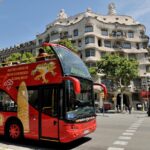
The practical trick is finding the right bus. The buses are pink and blue and named Bus Turístic. There are often multiple tour operators around the square area, so I recommend you look for the correct color and name, then confirm the route using the stop info at the boarding point.
Timing is straightforward: the first bus departs at 9:00 am and the last bus departs at 7:00 pm from Stop 1. That means you should not plan a last-minute hop-off at, say, 6:45 pm unless you enjoy stress.
If you’re the kind of person who hates wandering in circles, do this early: check the stop map (or ask at the stop) before you commit to a spot. A few guests reported missing part of the route because the exact stop location wasn’t clear enough. With this kind of hop-on bus, that can turn into a whole afternoon of frustration.
Finally, keep your voucher easy to access. Both mobile and printed vouchers are accepted, and you can redeem them at the stops along the routes. Also, buses run frequently, so once you’re onboard, the experience usually clicks quickly.
See more of Barcelona in one sweep



24 or 48 Hours: When Unlimited Really Pays Off

The tour itself is listed as about 120 minutes for a loop, and that’s helpful for planning. In a city with traffic lights, you may find the loop takes a bit longer in real life, so I suggest you think in ranges: “about two hours” plus extra time for getting on and off.
A 24-hour pass is the best fit when you have one strong sightseeing day and you want your “greatest hits” first. Ride a route once mostly for the overview, then jump off for the top sights you care about most. For example, you could do Gaudí highlights on one route, then return later to another area you liked.
A 48-hour pass is smarter if you want to slow down. Barcelona rewards second looks: the light changes, the streets get less crowded, and you can do half-day plans without rushing. On a 48-hour pass, you can ride part of one route, explore on foot, and then come back the next day for places you passed the first time.
The frequency matters here. The posted schedule is every 20 minutes, and there’s also a note that in high season buses can run about every 5 minutes, which helps avoid long waits at stops. Still, traffic is traffic—so if you’re hoping to time museum tickets back-to-back, build in buffer.
Red Route: From Montjuïc Funicular Area to the Beaches and La Rambla
One of the reasons I like Barcelona by bus is how the city shifts every few miles. The Red route tends to give you big views from higher ground, then gradually pulls you down toward the harbor and coastline.
Start where the city is easiest to understand: you’ll typically pass through Passeig de Gràcia in this system, with standout stops tied to Gaudí and design (including Casa Batlló and nearby highlights like Fundació Antoni Tàpies). From there, the route moves through central zones toward the south and the waterfront.
A big payoff on this route is the Montjuïc cluster. You’ll see stops tied to major Montjuïc landmarks and viewpoints, including Museu Nacional d’Art de Catalunya, Anella Olímpica, and areas near Telefèric de Montjuïc (Montjuïc Cable Car). There’s also a stop near Fundació Joan Miró, plus the Miramar gardens area. Even if you skip one ticketed attraction, these stops set you up to explore on foot, and you’ll usually understand the geography much faster than with subway-only days.
Then the route drops toward the water. Expect to pass through the harbor zone with stops like Port Olímpic, and then toward beaches including Platja del Bogatell and Platja Nova Mar Bella. If you’re picturing Barcelona as only Gothic alleys and Gaudí façades, this part corrects that fast. You get a sense of the city’s shoreline and the way the neighborhoods stretch along it.
The route also touches areas around World Trade Center, and it connects you toward zones like Forum and Parc Diagonal Mar. If you’re planning to eat later with ocean views or just want a break from street-level crowds, this is often where you can get your momentum back.
Finally, it swings back toward the old-school “walk and wander” area: La Rambla–Colom, with a stop near Museu d’Història de Catalunya. That’s a helpful end cap because you can hop off, go on foot, then re-board later.
The main drawback on the Red route is the same as the city: traffic and repeated stops can stretch your day. If you hate slow travel, you might feel like the bus is doing too much in between hits. On the other hand, if you want a working mental map, this is one of the best uses of your time.
Blue Route: Modernism, Park Güell, and the Tibidabo Direction
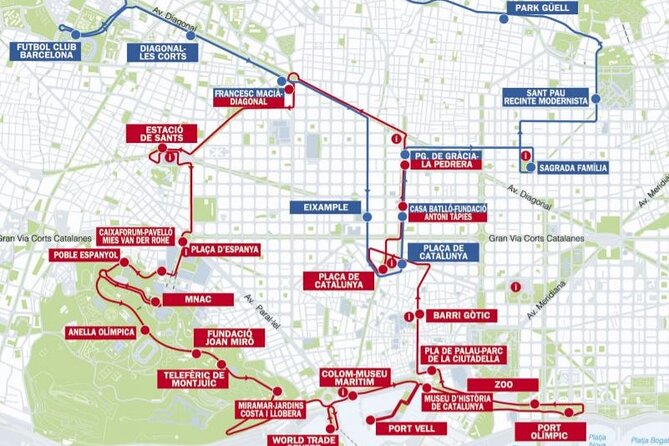
If the Red route helps you understand the city’s layout from Montjuïc to the coast, the Blue route is the one that leans hard into Barcelona’s “wow” architecture and hillside energy.
You’ll start again around the central core, with a focus on Passeig de Gràcia. This route includes major Gaudí-linked stops such as Casa Batlló and also moves toward La Pedrera (listed as Passeig de Gracia–La Pedrera). If you’re seeing Gaudí in one day, this is the zone to prioritize first.
Then comes a strong modernism sequence. A highlight here is Sant Pau Recinte Modernista. Even if you don’t enter, seeing it from the stop gives you a quick visual hook for why Barcelona’s design culture matters beyond just one architect.
The route also pushes toward the hillside experiences with stops tied to Park Güell and the Tramvia Blau–Tibidabo area. Park Güell is one of those places that rewards planning, because timing and crowds can shift fast. If you’re doing it, I’d suggest you use the bus to drop you near your time window, then treat the return ride as part of your schedule—not an afterthought.
From there, the Blue route travels through calmer areas like Sarria and toward historic sites such as Monestir de Pedralbes. It also connects you near Palau Reial–Pavellons Güell, and then moves again through city districts toward the big sports landmark area, including Futbol Club Barcelona.
As you head back, you pass major corridors like Diagonal and Francesc Macià. That matters because it helps you understand where the “big streets” are—and which parts of the city are really walkable between stops.
Like the Red route, the Blue route is a trade: you gain reach and context, but the bus is not a fast express. If you keep hopping on and off too aggressively, you can lose the benefit. The sweet spot is one or two long walk breaks per day, plus short transfers when needed.
Onboard Comfort: Audio in 16 Languages, Wi‑Fi, and Weather-Proofing

The onboard experience is built around three things: views, commentary, and convenience.
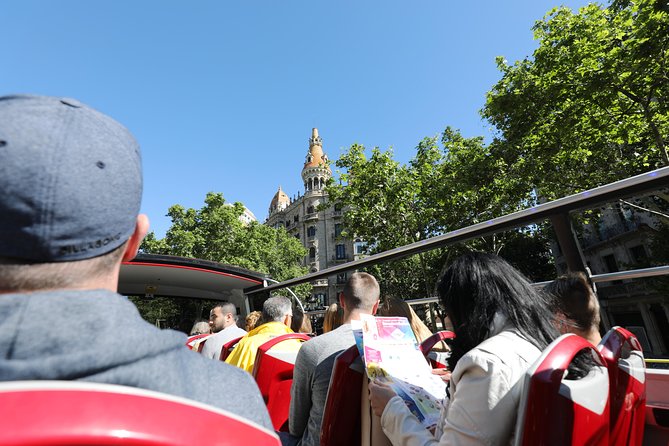
First: the open-top double-decker setup. That’s the reason this tour beats subway-only sightseeing. You see the city from above, and you’re not fighting station corridors to get a sense of where you are.
Second: audio commentary in 16 languages, with headphones. This is huge for first-time visitors. It means you can listen while you’re moving, instead of constantly reading signs or guessing what you’re seeing.
Third: free Wi‑Fi onboard. I wouldn’t count on it for heavy work, but it’s useful for quick maps, checking the next stop, or booking tickets for places you want to enter.
Now the weather part. The upper deck is exposed, and even if you stay under any covering, wind can still bite. One guest described rain and wind making it uncomfortable, and another suggested using warm clothing on colder evenings. My practical advice is to treat the open-top deck like an outdoor seat: bring a light rain layer or poncho, and wear something warm enough for a breeze.
There’s also a note from an accessibility-focused complaint: earphones may not fit comfortably over certain hearing aids. The audio setup is headphone-based, and if you use CIC or ITE hearing aids, I’d plan to confirm the earphone type or have a backup strategy. Don’t assume you’ll automatically get an over-ear alternative.
Service style can vary day to day. Some people praised staff as friendly and helpful, while others ran into rude or unhelpful interactions or felt they received incorrect guidance at a stop. That’s not something you can control, but you can control your margin for error: arrive early to stops, and give yourself extra time near the end of the day.
- Barcelona: Hola Barcelona Public Transport Travel Card★ 4.5 · 20,985 reviews
- Barcelona: 24 or 48-Hour Hop-On Hop-Off Bus Tour★ 4.4 · 20,872 reviews
- Barcelona: Park Guell Guided Tour with Skip The Line Entry★ 4.7 · 17,563 reviews
Where Each Major Stop Helps You Plan a Real Barcelona Day
A hop-on bus is at its best when it turns into a planning tool. Instead of using it as a single “ride forever” activity, I’d use it to build a day that matches your pace.
Here’s how I’d think about key stops, without trying to turn it into a race:
- Plaça de Catalunya: your orientation point. Ride from here early, then hop off to set your neighborhood base.
- Passeig de Gràcia zone: do this early if you care about Gaudí. Even a quick look from the bus helps you choose what to enter.
- Estació de Sants and Eixample connections: handy if you’re bouncing between transit and sightseeing.
- Montjuïc landmarks (including Museu Nacional and cable car area): good for a morning or late afternoon when you want views more than shopping.
- Fundació Joan Miró and Miramar gardens: useful if you like art plus scenery, not just one indoor attraction.
- Port Olímpic and beaches: best when you want a breather. Get off, walk, then come back when you’re ready.
- La Rambla–Colom: great for a classic walk. It’s not the calmest stretch, so hop off when you’re in a walking mood.
- Sagrada Família stop: if you’re visiting, use this as your drop-off, then schedule your entry time separately since tickets aren’t included.
You can also reduce stress by choosing a strategy:
- If you want the biggest overview, stay on longer and take photos from the upper deck.
- If you’re ticketed for a specific attraction, ride to the stop, then re-board later. Don’t try to do everything inside the bus ride itself.
Value Check: Price, Coupon Book Discounts, and What’s Not Included
The listed price I saw is $39.54 per person, and the value depends on how many hours you’ll actually ride.
You’re paying for:
- a 24- or 48-hour pass,
- unlimited use on the two routes during the validity window,
- onboard audio (16 languages) and headphones,
- free Wi‑Fi,
- and a coupon booklet with discounts described as totaling over 200 euros.
What’s not included matters. Entry to attractions is not included, so you still need separate tickets for places you want to go inside. That’s normal for hop-on bus tours, but it’s worth stating because it changes the math. This pass saves time and walking, but it doesn’t replace museum admissions.
I’d also think about the coupon book as a bonus, not the core reason to buy. If you happen to enter several top attractions listed in the coupon booklet, that can offset the cost. If you only plan one or two ticketed entries, the main value is still the sightseeing access and the stop coverage.
One more “value” angle from the day-to-day experience: some guests found the buses efficient and on time once they were on, and others noted that traffic can slow the loop. If you’re budgeting for time, build in buffer around transfers and plan major ticketed entries outside of peak bottleneck periods when possible.
Should You Book This Hop-On Hop-Off Bus in Barcelona?

I think you should book this if you fit one of these situations:
- It’s your first time in Barcelona and you want a fast orientation across neighborhoods.
- You want flexibility: ride, hop off, wander, then come back when you feel like it.
- You have limited time and want something that hits major sights across Gaudí sites, Montjuïc, La Rambla–Colom, and the waterfront.
I would hesitate if:
- You’re very sensitive to wind and rain on an open-top upper deck.
- You need a specific earphone fit for hearing aids (the standard headphone setup may be a problem for CIC/ITE users).
- You expect a perfectly precise start-point experience every day. Plaça de Catalunya is central, but you may need to confirm which stop-side matches your bus.
If you do book it, my best practical advice is simple: arrive a bit early at your first stop, double-check you’re boarding Bus Turístic, and keep your plan flexible. This bus works best as a launcher for your day, not a replacement for your own walking.
FAQ
How long is the bus loop?
The tour duration is listed as about 120 minutes.
Does the pass work for 24 or 48 hours?
Yes. You can choose either a 24-hour or 48-hour hop-on hop-off pass.
What times do buses run from the main starting stop?
The first bus departs at 9:00 am and the last bus departs at 7:00 pm (from Stop 1).
How often do the buses arrive?
Buses run about every 20 minutes. In high season, the tour notes that buses can run as often as every 5 minutes.
Are there two routes, and when do they operate?
There are two routes available. The Red and Blue routes operate all year round except 1st January and 25th December.
What’s included on the bus?
You get 360-degree panoramic views, 16-language audio commentary with headphones, access to onboard Wi‑Fi, and a coupon booklet with discounts.
Can I use a mobile ticket, or do I need printed vouchers?
Both mobile and printed paper vouchers are accepted. Vouchers can be redeemed at the stops along the routes.
All of Barcelona in One Sweep
- Barcelona: City Sightseeing Hop-On Hop-Off Bus Tour
★ 4.4 · 10,061 reviews - Barcelona City Tour Hop-On Hop-Off with Optional Boat
★ 4.0 · 3,012 reviews - Barcelona: City Walking Tour with a Local Guide
★ 4.9 · 1,384 reviews - Barcelona: Private City Tour by Eco Tuk Tuk
★ 4.9 · 1,339 reviews - Flamenco Show Ticket at Theatre Barcelona City Hall
★ 4.5 · 1,264 reviews
More Ways to Tour Barcelona
- Barcelona: Casa Batlló Entry with Self-Audioguide Tour
★ 4.7 · 25,359 reviews - Barcelona: 24 or 48-Hour Hop-On Hop-Off Bus Tour
★ 4.4 · 20,872 reviews - Barcelona: Park Guell Guided Tour with Skip The Line Entry
★ 4.7 · 17,563 reviews - Barcelona: Sagrada Familia Skip-the-Line Entry Ticket & Tour
★ 4.8 · 12,789 reviews - Barcelona: FC Barcelona Museum “Barça Immersive Tour” Ticket
★ 4.4 · 10,944 reviews
More Barcelona Tours on Our Radar
- Barcelona: Sagrada Familia Entry Ticket with Audio Guide
★ 4.6 · 105,312 reviews - Barcelona: Park Güell Admission Ticket
★ 4.4 · 76,534 reviews - Barcelona: Casa Batlló Entry with Self-Audioguide Tour
★ 4.7 · 25,359 reviews - Barcelona: Montjuïc Cable Car Roundtrip Ticket
★ 4.5 · 22,368 reviews - Barcelona: Hola Barcelona Public Transport Travel Card
★ 4.5 · 20,985 reviews
Just Rated Around Barcelona





City Tours, compared.
 ★ 4.4City Sightseeing Hop-On Hop-Off Bus TourFrom $3910,061 reviews
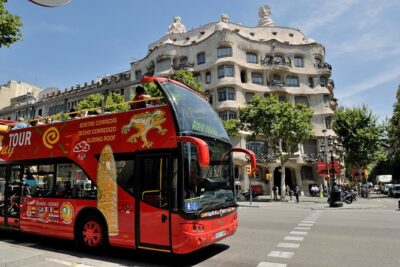 ★ 4.0Barcelona City Tour Hop-On Hop-Off with Optional BoatFrom $393,012 reviews
 ★ 4.9City Walking Tour with a Local GuideFrom $291,384 reviews
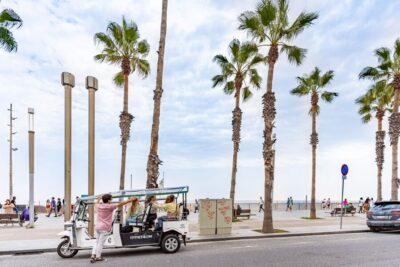 ★ 4.9Private City Tour by Eco Tuk TukFrom $331,339 reviews
 ★ 4.5Flamenco Show Ticket at Theatre Barcelona City HallFrom $301,264 reviews
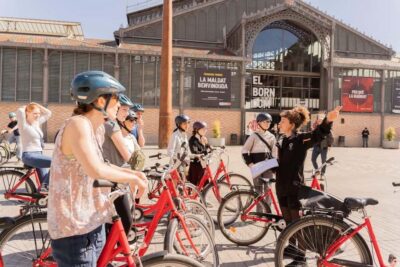 ★ 4.8Sagrada Familia or City Tour by Bike or eBikeFrom $33928 reviews
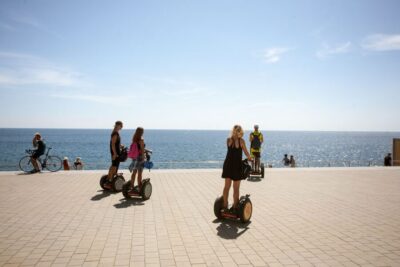 ★ 4.9City Highlights Guided Segway TourFrom $7624 reviews
 ★ 4.92-Hour City Sights Guided Segway TourFrom $27610 reviews
Browse the lists this tour appears in