
Reviewed · GOTHIC QUARTER TOURS
Gothic Quarter Insights & Tapas Experience
One of Europe’s best medieval strolls starts in plain sight. This Gothic Quarter walk blends archaeology-level street history with real Catalan flavor, so the old stones feel usable, not just pretty. I like that it ties Roman Barcelona to the Gothic city you’re walking through right now.
What really makes it work is the built-in pintxos and drink. I also like that the group stays small (max 20), which means your guide can actually steer attention to details instead of just reciting facts from a distance. You’ll hear the stories in English with guides who may also cover other languages like Spanish, French, and Italian.
One thing to keep in mind: this is a set-schedule walking experience, so if you show up late, you may miss the start. A couple of real-life comments flagged that timing matters, especially when meeting spots get crowded.
In This Review
- Key highlights to look for
- A 2.5-hour Gothic Quarter intro that also feeds you
- Starting at 3:30 pm: meeting point, small group, and walking reality
- Plaça Nova and the Barcino letters: how the Roman city starts the story
- Catedral de Barcelona and Portal del Bisbe: medieval walls, gates, and water
- Casa de l’Ardiaca and Placa Sant Felip Neri: church life and street-trade corners
- Placeta del Pi, Carrer de Montcada, and Plaça del Rei: where the quarter becomes navigable
- MUHBA Temple d’August and Santa Maria del Mar: surviving pieces of ancient and medieval life
- Price and value: pintxo, drink, and guide time for $54.06
- Who should book this Gothic Quarter Insights and Tapas walk
- Should you book this Gothic Quarter Insights and Tapas walk?
- FAQ
- How long is the Gothic Quarter Insights and Tapas experience?
- What time does the tour start, and where does it begin?
- What’s included in the price?
- What languages is the tour offered in?
- Is this a small group tour?
- Is free cancellation available?
Key highlights to look for
- Plaça Nova’s Barcino letters connects you to the Roman name behind Barcelona
- Portal del Bisbe and New Square turns medieval waterworks into a street-level story
- Casa de l’Ardiaca shows how Gothic design adapted through later centuries
- Placa Sant Felip Neri and guild echoes explain why the quarter feels like a maze
- MUHBA Temple d’August columns let you see more than dates; you see surviving stones
- Santa Maria del Mar gives you a Gothic landmark with a neighborhood-built origin
A 2.5-hour Gothic Quarter intro that also feeds you
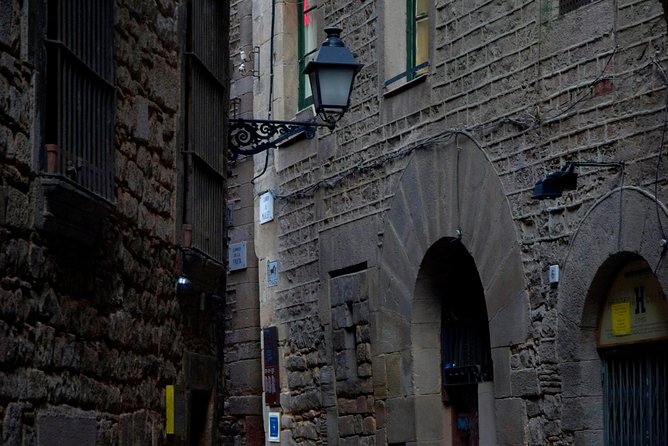
This tour is built for that specific Barcelona moment: you want the Gothic Quarter, but you also don’t want a long, slow day that turns into a blur. At about 2 hours 30 minutes, you get a structured walk through key medieval spaces, with your guide pointing out what most people walk past—sometimes literally because it’s tucked between buildings.
Then there’s the practical win: you’re not expected to hunt for lunch after a morning of museum time. You get one pintxo and one drink included, which keeps the energy up as the afternoon turns late. The best part is that the food ties into local rhythm. You’re learning the quarter, then you get to slow down and eat like locals do—standing, chatting, and nibbling instead of sitting forever.
If you care about architecture, religion, civic life, and the way Barcelona grew from Roman walls into a medieval power center, this format helps. You’ll leave with mental anchors: squares you can picture, streets you can follow, and buildings you can explain to friends without sounding like you memorized a brochure.
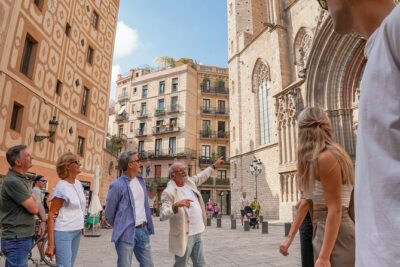
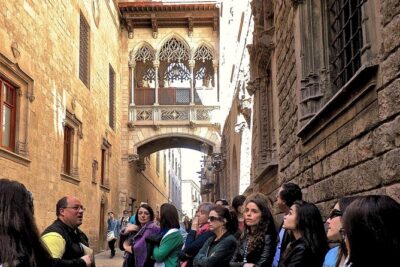
Deeper into the lanes of the Barri Gòtic
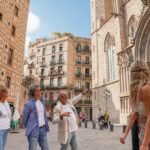


Starting at 3:30 pm: meeting point, small group, and walking reality
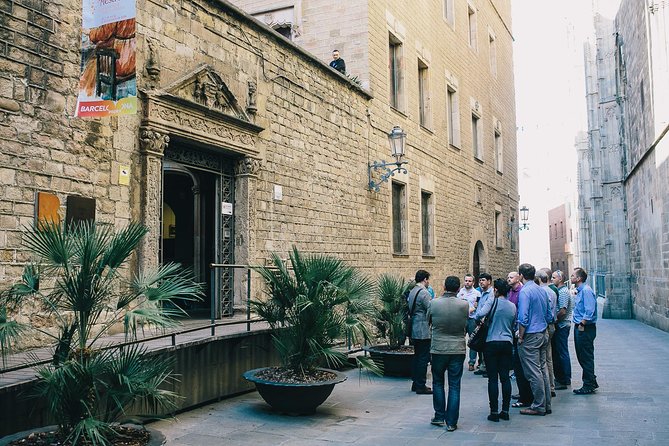
You start at Lamaro Hotel Barcelona, on Av. de la Catedral, 7 in Ciutat Vella. The tour begins at 3:30 pm and ends back at the same meeting point, which is convenient if you’re planning dinner nearby.
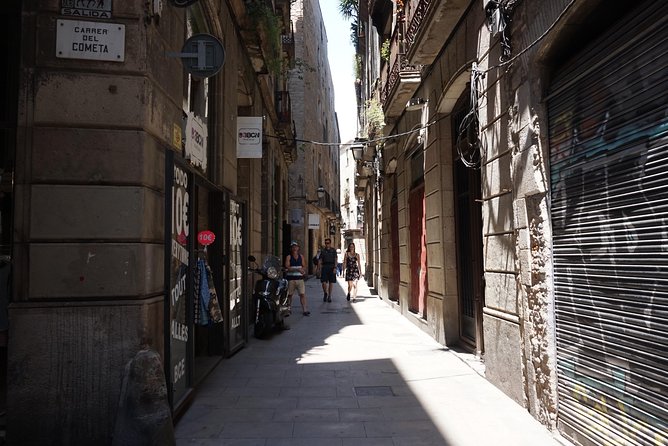
Because the group is capped at 20, you’ll usually get a more guided feel than you would on big bus-style tours. In smaller groups, guides can pause for questions and keep the pace moving without losing everyone at every corner. You’ll still be walking a fair amount, though. This is a classic old-streets route, so wear comfortable shoes and expect some uneven sidewalks.
Also, keep an eye out for the guide’s identifying look. One comment described finding the guide holding a red umbrella, which is a helpful mental trick if streets are crowded around your meeting spot.
If you’re doing Barcelona on a “fit in the best stuff” schedule—especially if you only have one afternoon to orient yourself in the Old Town—this start time works well. It’s late enough to avoid the harshest midday heat, but early enough that you still have energy left for your evening plans.
Plaça Nova and the Barcino letters: how the Roman city starts the story
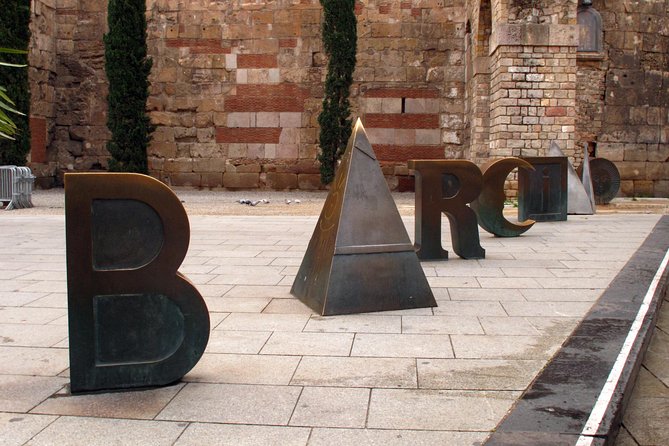
Your walk kicks off at Plaça Nova, where modern art meets ancient ground. The big letters spelling Barcino (Barcelona’s Roman name) sit almost cheek-to-wall with the former Roman city boundary. They were created by Barcelona-born artist Joan Brossa, and it’s a clever way to remind you that you’re standing on the origin point of the city—not just on a medieval postcard.
The letters are part bronze and part aluminum, bolted into place like a playful monument. It’s not a “learn it and forget it” stop. Instead, it gives you a key to everything else you’ll see: Barcelona’s layers didn’t replace each other; they stacked. When you understand that, the quarter stops feeling chaotic.
This first stop also has a good practical side. Plaça Nova is open enough that you can orient yourself fast, pictures are easy, and you’re ready for the older, tighter spaces to come. It’s the kind of start that makes the rest of the tour click.
Catedral de Barcelona and Portal del Bisbe: medieval walls, gates, and water
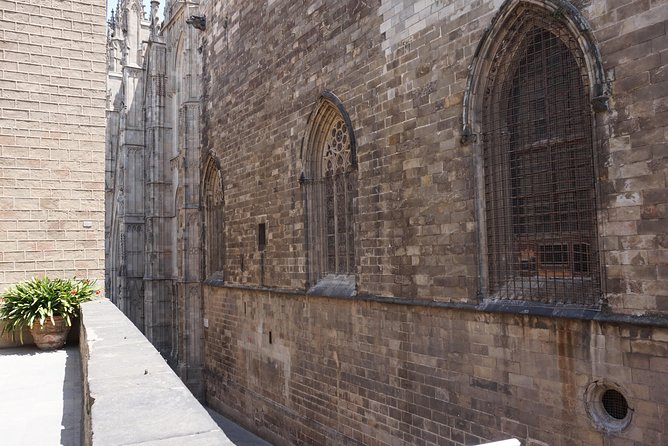
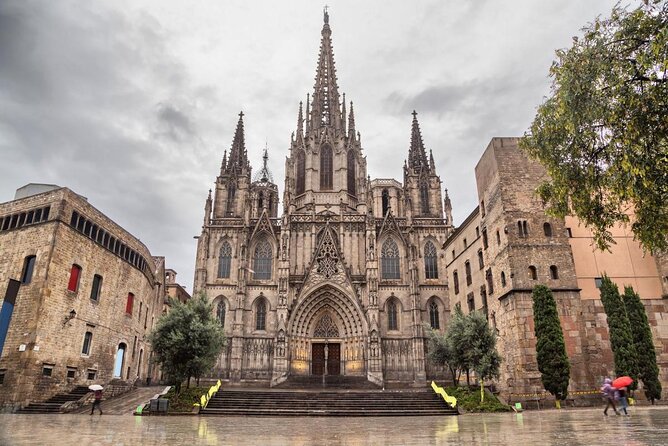
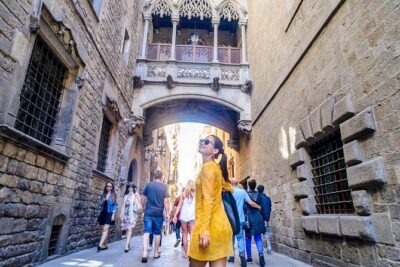
Next you’ll move toward the Catedral de Barcelona area, often referred to as the Palace of the Bishop. The key idea here is how the episcopal power rose by using the existing Roman urban fabric. In other words, the medieval authorities didn’t start from scratch; they repurposed what was already built.
A highlight is the connection to Portal del Bisbe, which links to the Porta Praetoria of the Roman wall. Then comes the New Square story—because medieval life ran on engineering as much as on prayers.
The New Square was opened in front of the Roman gate when water was channeled from Collserola toward the city. Buildings facing the portal were demolished in the process, and that’s why the space feels like a sudden breath in the Gothic Quarter maze. A small historical fact like this does a lot: it explains why the area looks the way it does and why certain views exist.
If you like city design, you’ll appreciate this stop. It’s not just, here’s a church. It’s: here’s how a city managed access, water, and authority at the same time.
Casa de l’Ardiaca and Placa Sant Felip Neri: church life and street-trade corners
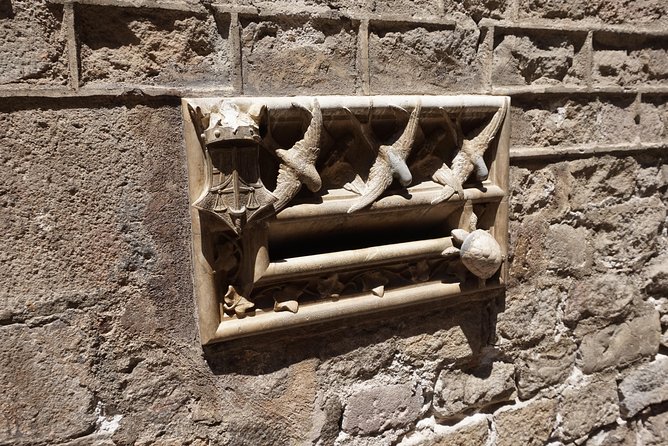
From the power of bishops, you shift to Casa de l’Ardiaca, the ecclesiastical residence that dates back to the 12th century and continued to evolve. This is the kind of stop that rewards close watching, because the building reflects changes over time rather than staying frozen in one style.
You’ll hear how alterations connected it more closely to the dean’s residence, including an early 16th-century phase that added a porticoed central courtyard. The decoration blends Renaissance touches with a flamboyant Gothic foundation, which helps you understand why Barcelona’s architecture can look like it’s talking to different eras at once.
Then the route dips into Placa Sant Felip Neri, a tiny square that feels like a secret pause. The square has a small fountain and is overlooked by the baroque church of Sant Felip Neri. What makes it interesting for your imagination is the surrounding context: the area once housed guild trades like shoemakers and coppersmiths, who relocated there from other streets.
This is a great contrast stop. You get religious architecture, then you get the trade-world edges that made the quarter run. Even if you’re not a history nut, it helps you understand why these streets feel the way they do—tight, indirect, and full of small destinations.
More tapas crawls worth the appetite
- Montserrat Half-Day Tour with Tapas and Gourmet Wines★ 5.0 · 7,359 reviews
- Montserrat & Cogwheel Train, Gourmet Wine Tasting & Tapas/Lunch★ 5.0 · 6,290 reviews
- Barcelona Tapas and Wine Experience Small-Group Walking Tour★ 5.0 · 5,804 reviews
Placeta del Pi, Carrer de Montcada, and Plaça del Rei: where the quarter becomes navigable
As you walk onward, you hit a trio that teaches you how to “read” the quarter.
Placeta del Pi is centered around a 14th-century church, and the older cemeteries around it have become small squares where painters and artisans show their work. Even when there’s no art in motion, the space still feels like it belongs to creative street life. It’s a reminder that the Gothic Quarter isn’t only about stone; it’s also about how people keep using these spaces.
Then you move into Carrer de Montcada, one of the most important medieval civic architecture corridors. This street starts with the Marcus chapel (12th century) and continues toward Plaça del Born. There’s also a timeline twist: until the 19th century, it was one unified street, but opening Carrer Princesa split it. That kind of change matters, because it’s one more way the city keeps rewriting itself.
Finally, you’ll reach Plaça del Rei, the medieval ensemble that’s often the most peaceful-feeling corner of this whole area. It’s surrounded by the royal palace complex, including the Palau Reial Major, and the atmosphere is the point. You can see why this space is associated with medieval Barcelona’s “center of gravity,” even now.
For me, these stops together are valuable because they turn navigation into something you can do in your head. After this walk, you’ll remember where to go next, instead of getting lost again five minutes later.
MUHBA Temple d’August and Santa Maria del Mar: surviving pieces of ancient and medieval life
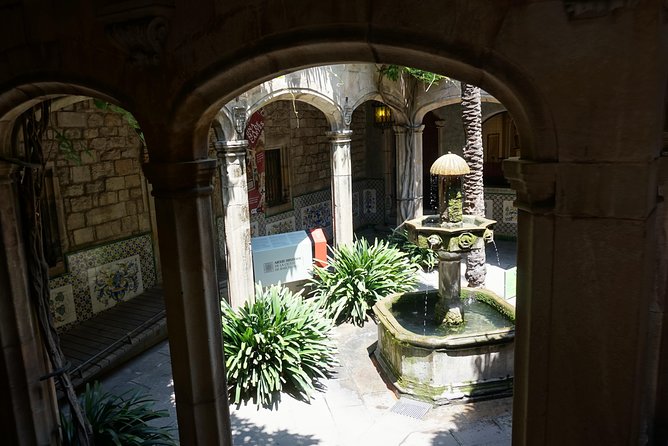
Two stops make this tour feel extra grounded: MUHBA Temple d’August and Basilica de Santa Maria del Mar.
At MUHBA Temple d’August, you’ll find a small medieval courtyard where four columns from the Temple of Augustus survived. They’re more than 2,000 years old, and seeing surviving elements like this hits differently than reading a timeline. This is the kind of stop that helps the quarter stop being a background and start being a layered living place.
Then you’ll reach Santa Maria del Mar, widely seen as the real Old Town cathedral because it was founded and constructed in medieval times by local neighborhood people. That neighborhood-built origin matters. It means the building isn’t just tied to elites; it’s tied to ordinary community effort. Architecturally, it’s a strong example of Catalan Gothic, so it gives you that clean, distinctive Gothic feel without needing extra guesswork.
If you’re wondering what makes this tour worth more than a basic sights walk, it’s this part. You’re not only seeing famous facades. You’re understanding what survived, what got reused, and who paid for what through different centuries.
Price and value: pintxo, drink, and guide time for $54.06
At $54.06 per person, this isn’t the cheapest thing in Barcelona. But it’s also not priced like a museum day. For the money, you’re paying for three real components:
1) A guided walk of about 2.5 hours through concentrated highlights
2) One pintxo and one drink, handled for you at the end
3) A professional guide available in English, with multilingual coverage noted for Spanish, French, and Italian
Here’s the value logic I like: the tour makes the Old Town easier to understand while you’re still there. If you try to DIY this route, you can spend an hour just figuring out what you’re looking at, then another hour hunting for food on top of it. Here, you get food without losing your walking momentum, and you get explanations at the exact moment your eyes land on the detail.
Also, the group size helps value. With up to 20 people, you’re less likely to get stuck in a long line of identical listening. The tour tends to work best when the guide can keep eyes moving and answer quick questions.
You’ll see guide personality show up in the feedback: guides such as Ariana and Leah are praised for enthusiasm and the way they bring the Gothic Quarter to life; Núria is noted for being friendly and story-filled; Maria is also singled out for being especially enjoyable. That matters, because the quarter can be overwhelming without a guide who knows how to pace the story.
Who should book this Gothic Quarter Insights and Tapas walk
I think this tour is best for you if you:
- Want a fast orientation to Barcelona’s oldest streets in one afternoon
- Care about how cities grow from Roman walls to medieval power
- Like small-group walking with time to look at details, not just pass by them
- Would rather have a local snack stop included than gamble on where to eat next
It may not be your perfect match if you’re after a super story-heavy, legend-only experience. One comment suggested wanting more legends and less straightforward building history. If that’s your priority, you might want to look for a more folklore-driven option. That said, you still get plenty of human-scale stories tied to guilds, churches, and changing streets.
Also, be realistic about timing. If you arrive late, there’s a chance you won’t catch up to the group at the exact start moment. Old streets make it easy to underestimate walking time, crowds, and confusion.
Should you book this Gothic Quarter Insights and Tapas walk?
Yes, if you want a high-return afternoon: medieval architecture, Roman leftovers, and a practical snack wrapped into one route. The included pintxo and drink sweeten the deal, and the small-group setup usually keeps the tour feeling personal rather than crowded and rushed.
My quick decision rule: if you like Barcelona best when it’s specific and textured—Roman layers, Gothic squares, community-built churches—book it. If you only want one or two landmarks and prefer long unstructured wandering, you might do just fine on your own.
FAQ
How long is the Gothic Quarter Insights and Tapas experience?
It lasts about 2 hours 30 minutes.
What time does the tour start, and where does it begin?
It starts at 3:30 pm and meets at Lamaro Hotel Barcelona, Av. de la Catedral, 7, Ciutat Vella, 08002 Barcelona, Spain.
What’s included in the price?
You get one pintxo and one drink, plus a professional guide.
What languages is the tour offered in?
The experience is offered in English, and the guide is listed as multilingual (including English/Spanish and French, with Italian also mentioned).
Is this a small group tour?
Yes. It has a maximum of 20 travelers.
Is free cancellation available?
Yes. You can cancel up to 24 hours in advance for a full refund.
More Barcelona Tours on Our Radar
- Barcelona: Sagrada Familia Entry Ticket with Audio Guide
★ 4.6 · 105,312 reviews - Barcelona: Park Güell Admission Ticket
★ 4.4 · 76,534 reviews - Barcelona: Casa Batlló Entry with Self-Audioguide Tour
★ 4.7 · 25,359 reviews - Barcelona: Montjuïc Cable Car Roundtrip Ticket
★ 4.5 · 22,368 reviews - Barcelona: Hola Barcelona Public Transport Travel Card
★ 4.5 · 20,985 reviews
One More Tapas Crawl
- Montserrat Half-Day Tour with Tapas and Gourmet Wines
★ 5.0 · 7,359 reviews - Montserrat & Cogwheel Train, Gourmet Wine Tasting & Tapas/Lunch
★ 5.0 · 6,290 reviews - Barcelona Tapas and Wine Experience Small-Group Walking Tour
★ 5.0 · 5,804 reviews - Montserrat with Black Madonna & Medieval Winery with Tapas/Lunch
★ 5.0 · 5,209 reviews - Barcelona: Tapas Walking Tour with Food, Wine, and History
★ 4.8 · 4,261 reviews
Lost in the Gothic Quarter
- Barcelona in 1 Day: Sagrada Familia, Park Guell,Old Town & Pickup
★ 5.0 · 13,541 reviews - Barcelona all included: Sagrada, Park Güell, Montjuic & Gothic
★ 5.0 · 2,169 reviews - Barcelona: Sagrada Familia, Modernism, and Old Town Tour
★ 4.7 · 1,621 reviews - Barcelona Gothic Quarter Tapas & Taverns Food & Wine Tour
★ 5.0 · 1,470 reviews - Barcelona Helicopter, Sailboat & Old Town Private Walking Tour
★ 5.0 · 1,395 reviews
Just Rated Around Barcelona





Gothic Quarter Tours, compared.
 ★ 5.0Barcelona in 1 Day: Sagrada Familia, Park Guell,Old Town & PickupFrom $12013,541 reviews
 ★ 5.0Barcelona all included: Sagrada, Park Güell, Montjuic & GothicFrom $1192,169 reviews
 ★ 4.7Sagrada Familia, Modernism, and Old Town TourFrom $521,621 reviews
 ★ 5.0Barcelona Gothic Quarter Tapas & Taverns Food & Wine TourFrom $1311,470 reviews
 ★ 5.0Barcelona Helicopter, Sailboat & Old Town Private Walking TourFrom $5131,395 reviews
 ★ 4.8Old Town and Gothic Quarter Walking TourFrom $211,393 reviews
 ★ 4.7Helicopter, Boat Ride & Old Town Private TourFrom $5001,357 reviews
 ★ 5.0Barcelona Old Town & Gothic Quarter Small Group TourFrom $221,308 reviews
Browse the lists this tour appears in