
Reviewed · GOTHIC QUARTER TOURS
Introduction to Barcelona’s Old Town Gothic Quarter Walking Tour
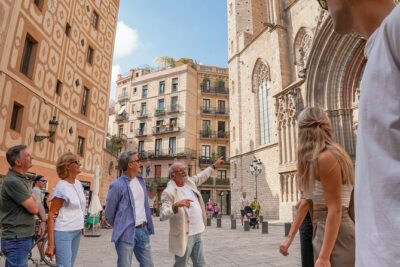
Two thousand years in two hours. I love how this Gothic Quarter walk turns what you see into what it means, starting right at Edifici de Correus instead of a random street corner. The guide doesn’t run a fixed script; they shape the route to your interests, the time of year, the day of the week, and even the weather.
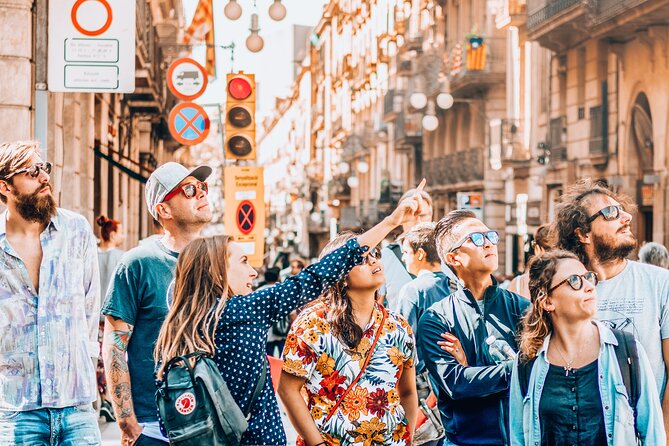
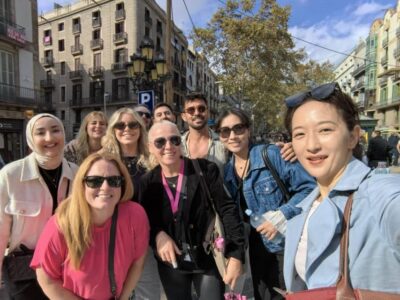
I also love the pacing and scale: a small group (max 10 adults) makes it feel like a conversation, not a herd with headsets. In English, you’ll get clear explanations of Barcelona and Catalonia, plus smart post-tour suggestions from guides like Laura and Matthew.
One thing to weigh: this is largely an outside-walk. Many stops don’t include paid entry, so if you want inside-access to major sights, you’ll need to plan that separately.
In This Review
- Key highlights to look for on the walk
- Where you start: Edifici de Correus and the art of noticing
- The first wow: Lichtenstein’s El Cap and Barcelona’s modern attitude
- Santa Maria del Mar: Gothic that feels built by regular people
- Pont del Bisbe’s charm has a dark joke under the stone
- Casa de l’Ardiaca: from Roman house to archive courtyard
- Plaça de Sant Jaume: the square that still runs the show
- A quick Roman reset: aqueduct traces and the idea of hidden infrastructure
- Font dels Senyors: a Gothic fountain for everyday life
- Picasso in brutalist mode: Col·legi d’Arquitectes friezes
- Capella de Santa Àgueda: small chapel, famous altarpiece inside
- Monument als Castellers: the moment a community lifts someone up
- Palau Reial Major and the theatre of medieval power
- Roman walls you can feel: Muralla Romana
- Plaça Reial: Gaudí streetlamps and a fountain built for meeting
- Palau Episcopal and Palau Centelles: power with a quieter voice
- Casa Llotja de Mar: merchant deals, then a new architectural wrapper
- The Archive of the Crown of Aragon: history stored, not performed
- Capella de Santa Llúcia and the quiet layers beside the cathedral
- Basilika dels Sants Just i Pastor: old Christian roots without the noise
- MUHBA Temple d’August: four Roman columns in a medieval courtyard
- Barcelona Cathedral exterior: the symbols are the show
- Plaça del Rei: where medieval Barcelona feels like a closed-in stage
- Plaça Reial again: end at the city’s comfortable chaos
- Price and value: what $43.37 buys you (and what it doesn’t)
- Who should book this Gothic Quarter walk
- Should you book it?
- FAQ
- Is the tour in English?
- How long is the Gothic Quarter walking tour?
- What is the group size?
- Where does the tour start and end?
- Do I need to print a ticket?
- Are admission fees included?
- Is it close to public transportation?
- Can I get a full refund if I cancel?
Key highlights to look for on the walk
- Edifici de Correus as your landmark start: those big columns on the eastern façade make it easy to regroup.
- Outside details with inside stories: bridges, courtyards, and façades explained so you notice more than you thought you would.
- Plaça de Sant Jaume’s power showdown: City Hall on one side, the Catalan government palace on the other.
- Art where it surprises you: Roy Lichtenstein’s El Cap, Picasso friezes, and early Gaudí lamps.
- Roman Barcelona keeps resurfacing: aqueduct traces, Roman wall blocks, and Temple d’August columns.
- A guide who customizes: you’ll get practical direction on what to eat and where to go next.
Where you start: Edifici de Correus and the art of noticing
You’ll meet at Pl. de Correus, 1 in Ciutat Vella, at the Old Town Post Office, Edifici de Correus. Most people rush past the building’s fine details, but the guide uses it as a warm-up in how to read Barcelona’s architecture.
Look for the carved symbolism and the grand stair feel. Those four massive columns on the eastern façade work like a visual cue: a calm, central meeting point that helps you start relaxed.
Deeper into the lanes of the Barri Gòtic


The first wow: Lichtenstein’s El Cap and Barcelona’s modern attitude
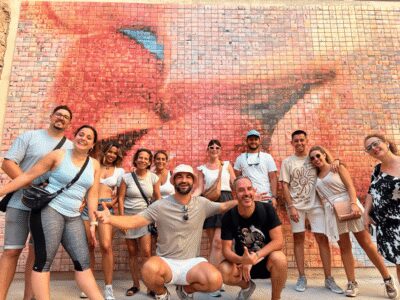
From the post office, the route turns toward the port area for El Cap de Barcelona. It’s impossible to miss once you know what you’re looking at: Roy Lichtenstein’s Olympic-era “The Head,” covered in ceramic mosaic over concrete.
The face is intentionally playful—red lips, a squiggly blue line for hair—meant as a tribute to Barcelona’s modernism and its love for tilework. A lot of cities keep their old and their new in separate boxes; here, the city happily puts them in the same frame.
Santa Maria del Mar: Gothic that feels built by regular people
Next comes Basilica de Santa Maria del Mar, built from 1329 to 1383. The big point isn’t just how tall and clean it looks; it’s that it was funded by local merchants, sailors, and stonemasons rather than royalty or bishops.
You get a “fortress-and-faith” vibe from the exterior, and inside the story becomes even more human: porters carved into the entrance and a connection to the stones brought from Montjuïc. It’s one of those stops where the architecture matches the community behind it.
Pont del Bisbe’s charm has a dark joke under the stone
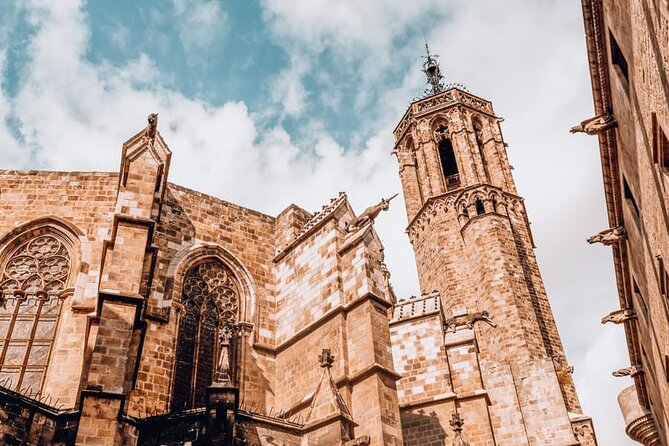
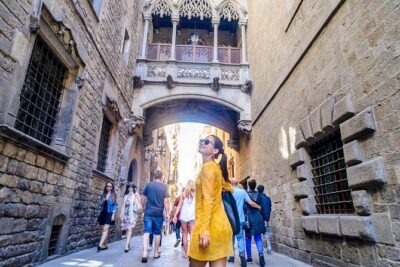
Then you’ll pause at Pont del Bisbe. The bridge looks medieval, but it was built in 1928 as part of a romantic push to make the Gothic Quarter feel more “medieval” again.
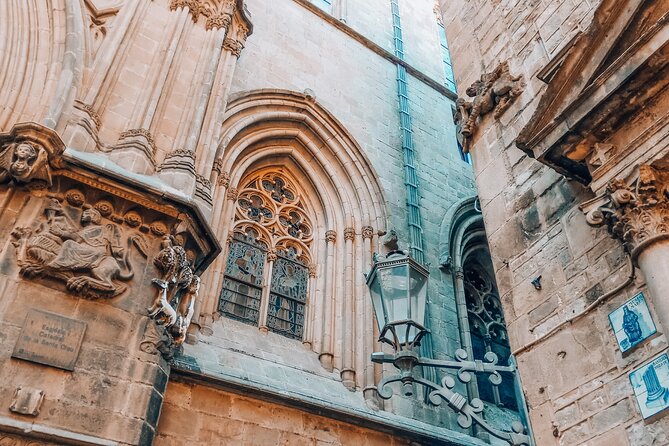
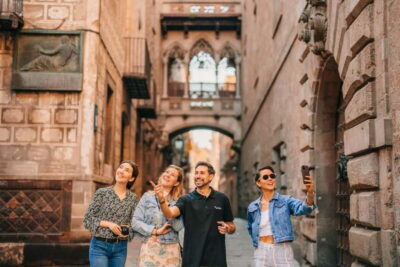
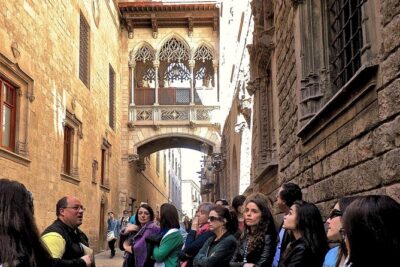
Up close, it’s all intricate neo-Gothic stonework and photogenic curves. Under the bridge is the kicker: a skull pierced by a dagger carved into the underside, and the city’s legends attach a warning to messing with it.
If you like your sightseeing with a sense of theater, this is a great moment.
Casa de l’Ardiaca: from Roman house to archive courtyard
Right by the cathedral area, you’ll reach Casa de l’Ardiaca. It started as a Roman house, then became a medieval residence for an archdeacon, and today it’s tied to the city’s historical archives.
Even from outside, you can feel the layers: it’s an elegant space with a quiet inner courtyard and small Gothic flourishes. The detail that really keeps people talking is the modernist mailbox on the outer wall—designed in 1902 by Domènech i Montaner and loaded with symbolic weirdness.
More Barcelona streets to take slowly
- Barcelona Tapas and Wine Experience Small-Group Walking Tour★ 5.0 · 5,804 reviews
- Barcelona: Tapas Walking Tour with Food, Wine, and History★ 4.8 · 4,261 reviews
- Barcelona: Food Walking Tour with Tapas and Wine★ 4.9 · 2,180 reviews
Plaça de Sant Jaume: the square that still runs the show
This is where the walk becomes political in the most useful way. Barcelona City Hall (Ajuntament de Barcelona) sits across from Palau de la Generalitat de Catalunya on Plaça de Sant Jaume.
Ajuntament de Barcelona is neoclassical on the outside, but it represents municipal power and the constant back-and-forth of governance. The Generalitat palace is Catalonia’s government seat with a façade that reads Renaissance calm—while Saint George, the dragon-slayer, shows up as a repeating symbol.
The square itself is intentionally bare. That matters because it keeps the focus on where decisions happen, including castells built here during celebrations.
A quick Roman reset: aqueduct traces and the idea of hidden infrastructure
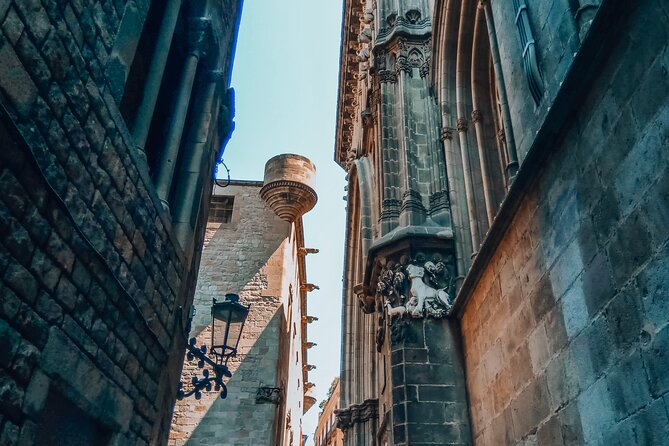
Between the power squares and the port-side buildings, the tour drops in Roman Aqueduct (Aqüeducte Romà) near Plaça Nova. What’s left isn’t a dramatic skyline of arches; it’s modest and easy to miss.
That’s the point. It once carried water from the Collserola hills into Roman Barcino, and today a reconstructed stretch appears near the old city entrance, arching toward modern walls. When you spot it, you get a clear lesson: ancient cities ran on systems you mostly don’t see.
Font dels Senyors: a Gothic fountain for everyday life
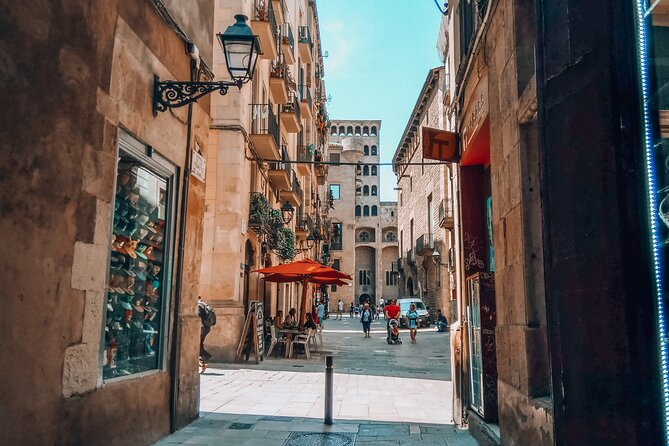
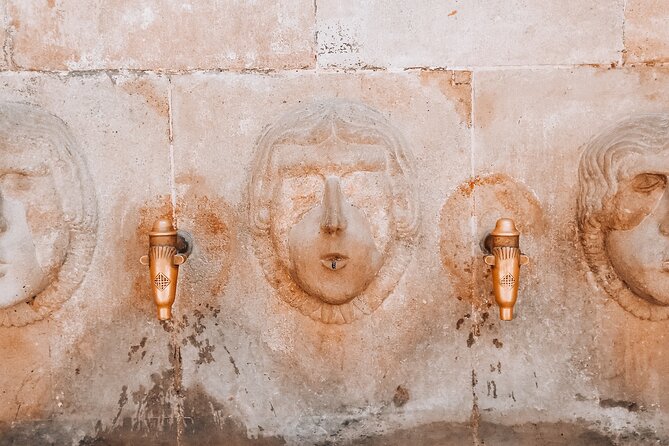
Next is Font dels Senyors, sometimes overlooked because it isn’t monumental. It’s a Gothic fountain tied to medieval water systems that served noble residences.
Stonework here is simple compared to palaces and churches, but it has wear that suggests real daily use. You’re looking at a reminder that medieval power still needed basic routines.
Picasso in brutalist mode: Col·legi d’Arquitectes friezes
Now you hit Col.legi d’Arquitectes de Catalunya, where the Els Tres Frisos de la Mediterrània show up. These are big concrete friezes facing the cathedral from across Plaça Nova, designed by Picasso and carved by Carl Nesjar in the 1960s.
They depict playful Mediterranean themes like children and myth figures, but they’re carved into raw, sandblasted concrete. That mix of a modern artwork language next to carefully protected heritage is the message: Barcelona doesn’t only preserve the past—it also argues with it.
Capella de Santa Àgueda: small chapel, famous altarpiece inside
At Capella de Santa Àgueda, the exterior looks modest beside the royal complex. Built in the 14th century for royal use, it’s a Catalan Gothic chapel with narrow windows and a kind of austere quiet.
The big payoff is what’s linked to the chapel: the Epiphany Altarpiece by Jaume Huguet. The tour often keeps you outside, but the guide points out why this tight fit into the royal square matters—religion and authority shared the same architectural space here.
Monument als Castellers: the moment a community lifts someone up
Then comes Monument als Castellers, a sculpture celebrating the human tower tradition. In real castells, teams build up to ten levels, balancing strength, precision, and trust across families and neighbors.
The sculpture freezes the moment the enxaneta raises their hand at the top. You can walk around it and really see the tension in the faces and the unity in the poses.
It’s one of those stops that turns Barcelona from buildings into lived identity.
Palau Reial Major and the theatre of medieval power
At Palau Reial Major, you’re looking at layers of royal buildings, not one simple palace. The Saló del Tinell is the standout Gothic section with big arches meant to impress visiting nobles.
Nearby, Mirador del Rei Martí rises as a watchtower added in the 16th century. It’s named for King Martin, but the key point for you is what the tower symbolizes: status and visibility, even when “defense” wasn’t the real story.
And yes, the guide weaves in the big-location vibe of royal gatherings around this square, including the long-running Columbus connection tied to the area.
Roman walls you can feel: Muralla Romana
At Muralla Romana, you get one of the most grounding moments on the whole walk. This Roman wall dates to the late 3rd and early 4th century CE and once enclosed Barcino with towers and gates.
Some sections are still standing, including blocks that show how later buildings reused Roman materials. You’ll see massive stone fitted without mortar, plus hints of reused inscriptions or column fragments tucked into masonry.
If you’ve ever wondered how a modern city can still contain the ancient one, this is the place where the answer becomes physical.
Plaça Reial: Gaudí streetlamps and a fountain built for meeting
Next, you’ll reach Faroles Modernistes de Gaudí near Plaça Reial. These elegant streetlamps are early Gaudí work from 1879, and they’re easier to appreciate when you know the details: vine-like twisting elements and a winged helmet linked to Mercury.
Then the tour lands on Font de les Tres Gràcies in the center of Plaça Reial. The Three Graces fountain is 19th century and designed in a classical style that fits the square’s ornate arches and palm trees.
This is also a practical stop. Sit for a minute, people-watch, and use the square as your reset point before the tour loops back toward the cathedral complex.
Palau Episcopal and Palau Centelles: power with a quieter voice
Near the cathedral, the walk passes Palau Episcopal de Barcelona. Even without going inside, you can see it as an operational piece of church authority since the Romanesque period.
A bit further along is Palau Centelles, a late Gothic noble residence associated with the Centelles family. It’s less showy than some palaces, but the coat of arms and pointed façade details keep the story clear: here, power was fortified and close to politics.
Casa Llotja de Mar: merchant deals, then a new architectural wrapper
At Casa Llotja de Mar, the story turns to commerce. Originally a 14th-century merchant exchange overlooking the old port, it later received an 18th-century neoclassical shell, which shapes what you see today.
The guide’s angle is worth paying attention to: you’re looking at a building that helped Barcelona grow by hosting traders, shipowners, and bankers. And there’s a modern artistic thread too—Gaudí studied architecture here, according to the tour information.
The Archive of the Crown of Aragon: history stored, not performed
Then you’ll pause at General Archive of the Crown of Aragon (Arxiu de la Corona d’Aragó). This is a Gothic building tied to one of Europe’s oldest archives, founded in the 14th century.
From the outside, it looks sober and practical, like it was built to protect memory. The guide frames the value simply: sometimes history isn’t a monument—it’s preserved paper and records.
Capella de Santa Llúcia and the quiet layers beside the cathedral
At Capella de Santa Llúcia, the chapel is one of the oldest surviving parts of the cathedral complex. Built in the late 13th century, it began as a funerary chapel and later served as headquarters for a religious nursing order.
It’s early Gothic with a low, solid feel and narrow windows. The tour highlights how worn inscriptions and details can communicate long community use even when the chapel stays modest in size.
Basilika dels Sants Just i Pastor: old Christian roots without the noise
Next is Basílica dels Sants Just i Pastor, named after two Roman children executed for refusing to renounce their faith. The site has held churches since at least the 4th century, even though the current Gothic structure dates to the 14th century.
This is a calmer stop—more solitude than spectacle. If you want a moment where the Gothic lines feel clean and the air feels less crowded, this one helps.
MUHBA Temple d’August: four Roman columns in a medieval courtyard
One of the smartest stops is MUHBA Temple d’August. Hidden behind a narrow doorway, you see four tall Roman columns remaining from the Temple of Augustus in Barcino.
It’s the kind of Barcelona surprise that makes the whole walk click: ancient Rome was buried, built over, and nearly forgotten—then reappears right where you’d least expect it. Entry is free, and even if you don’t go inside, the guide usually points out the doorway logic so you don’t miss it.
Barcelona Cathedral exterior: the symbols are the show
Then you arrive at Barcelona Cathedral (Catedral de Barcelona). It’s a textbook Gothic landmark, officially the Cathedral of the Holy Cross and Saint Eulàlia.
From outside, you can still read the medieval imagination: sculpted saints and odd carvings, including an elephant and a unicorn. The tour also notes the tradition tied to Saint Eulàlia—13 geese in the cloister—and explains how that symbolism feeds the cathedral’s identity.
If you plan to go inside later, this outside stop helps you know where to look first.
Plaça del Rei: where medieval Barcelona feels like a closed-in stage
After the cathedral exterior, you’ll spend time at Plaça del Rei. It’s framed by royal and Gothic chapels, with stone staircases and an enclosed feel that makes the past feel close.
The key value here is how the square pulls together the tour’s themes: kings, civic ceremony, revolts, and everyday religious spaces all share the same stone bowl. Stand still for a minute and you’ll feel why this is one of the best places to let the stories “settle in.”
Plaça Reial again: end at the city’s comfortable chaos
The walk finishes at Plaça Reial, near La Rambla. It’s one of Barcelona’s classic public squares with neoclassical arches, palm trees, and those same early Gaudí lamps framing the space.
Expect life around cafés and musicians, plus plenty of photo angles. Use it as your launchpad—drink water, grab a snack, then follow the guide’s suggestions for where to eat and what to see next.
Price and value: what $43.37 buys you (and what it doesn’t)
At $43.37 per person for about 2 hours 35 minutes, the value comes from interpretation, not ticketed entry. This tour is priced to keep you walking through the city’s visible layers—often without paid admissions.
That means you get a strong foundation without paying for multiple entrances. It also means you won’t automatically get inside access to every major site, because the itinerary favors outside views and architectural storytelling.
If you’re doing Barcelona for the first time, that’s a win. You’ll finish knowing what to prioritize on your own schedule, instead of spending time guessing.
Who should book this Gothic Quarter walk
This tour is a great match if you want a guided “how to look” lesson while seeing real landmarks tied to Roman, medieval, and modern Barcelona. It also works well for return visitors who think they already know the Gothic Quarter, because the art and power-squares angle changes what you notice.
It’s less ideal if you hate walking or need frequent indoor stops. The route keeps moving, with many short pauses rather than long museum-style time.
Should you book it?
Yes—if your goal is to understand the Gothic Quarter beyond surface photos. Start with this to get your bearings fast, then pick a few places from what you learned for deeper time.
If you’re chasing only paid ticket attractions and inside rooms, you might feel the limits of an outside-focused route. But if you enjoy details—skulls under bridges, symbolic fountains, Roman stones inside medieval walls—this is an efficient way to make Barcelona’s layers click.
FAQ
Is the tour in English?
Yes. The tour is offered in English.
How long is the Gothic Quarter walking tour?
It runs for about 2 hours 35 minutes.
What is the group size?
The group is limited to a maximum of 10 travelers.
Where does the tour start and end?
It starts at Pl. de Correus, 1, Ciutat Vella, Barcelona, and it usually ends near Plaça Reial (Plaça Reial, Ciutat Vella, Barcelona).
Do I need to print a ticket?
No. The tour uses a mobile ticket.
Are admission fees included?
No. Admission fees are not included, since the tour typically does not enter buildings that require a fee.
Is it close to public transportation?
Yes, it’s near public transportation.
Can I get a full refund if I cancel?
Yes. You can cancel up to 24 hours in advance for a full refund. Cancellation within 24 hours of the start time is not refunded.
More Ways to Tour Barcelona
- Barcelona: Casa Batlló Entry with Self-Audioguide Tour
★ 4.7 · 25,359 reviews - Barcelona: 24 or 48-Hour Hop-On Hop-Off Bus Tour
★ 4.4 · 20,872 reviews - Barcelona: Park Guell Guided Tour with Skip The Line Entry
★ 4.7 · 17,563 reviews - Barcelona: Sagrada Familia Skip-the-Line Entry Ticket & Tour
★ 4.8 · 12,789 reviews - Barcelona: FC Barcelona Museum “Barça Immersive Tour” Ticket
★ 4.4 · 10,944 reviews
More Barcelona Tours on Our Radar
- Barcelona: Sagrada Familia Entry Ticket with Audio Guide
★ 4.6 · 105,312 reviews - Barcelona: Park Güell Admission Ticket
★ 4.4 · 76,534 reviews - Barcelona: Casa Batlló Entry with Self-Audioguide Tour
★ 4.7 · 25,359 reviews - Barcelona: Montjuïc Cable Car Roundtrip Ticket
★ 4.5 · 22,368 reviews - Barcelona: Hola Barcelona Public Transport Travel Card
★ 4.5 · 20,985 reviews
Lost in the Gothic Quarter
- Barcelona in 1 Day: Sagrada Familia, Park Guell,Old Town & Pickup
★ 5.0 · 13,541 reviews - Barcelona all included: Sagrada, Park Güell, Montjuic & Gothic
★ 5.0 · 2,169 reviews - Barcelona: Sagrada Familia, Modernism, and Old Town Tour
★ 4.7 · 1,621 reviews - Barcelona Gothic Quarter Tapas & Taverns Food & Wine Tour
★ 5.0 · 1,470 reviews - Barcelona Helicopter, Sailboat & Old Town Private Walking Tour
★ 5.0 · 1,395 reviews
Just Rated Around Barcelona
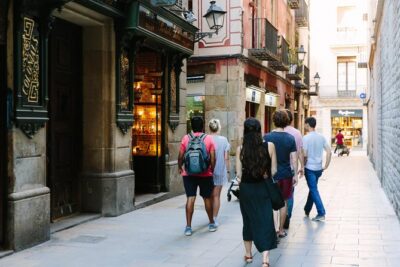





Gothic Quarter Tours, compared.
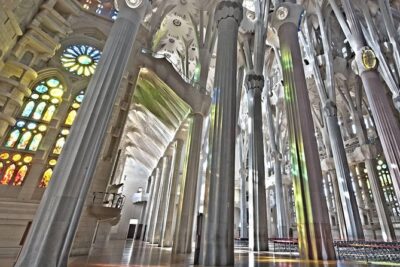 ★ 5.0Barcelona in 1 Day: Sagrada Familia, Park Guell,Old Town & PickupFrom $12013,541 reviews
 ★ 5.0Barcelona all included: Sagrada, Park Güell, Montjuic & GothicFrom $1192,169 reviews
 ★ 4.7Sagrada Familia, Modernism, and Old Town TourFrom $521,621 reviews
 ★ 5.0Barcelona Gothic Quarter Tapas & Taverns Food & Wine TourFrom $1311,470 reviews
 ★ 5.0Barcelona Helicopter, Sailboat & Old Town Private Walking TourFrom $5131,395 reviews
 ★ 4.8Old Town and Gothic Quarter Walking TourFrom $211,393 reviews
 ★ 4.7Helicopter, Boat Ride & Old Town Private TourFrom $5001,357 reviews
 ★ 5.0Barcelona Old Town & Gothic Quarter Small Group TourFrom $221,308 reviews
Browse the lists this tour appears in