
Reviewed · GOTHIC QUARTER TOURS
Private Barcelona Old Town Walking Tour: Gothic Quarter & Born
Barcelona’s old streets feel personal fast. In a private 3-hour route through the Gothic Quarter and Born, you get a guided, stop-by-stop orientation of Barcelona’s layers, from Roman traces to medieval power. I like how the walk connects the landmarks to what was happening in the city, and I like the lively guide energy, with real-world explanations like what to notice and why it matters.
One thing to plan around: a couple of key sights have admission not included, and the timing is built for short looks, not long interior visits. Also, you’ll move through high-traffic areas like Las Ramblas, so wear good shoes and expect crowds near the center.
In This Review
- Key highlights you’ll feel on the walk
- Meeting point on Passeig de Gràcia: getting started without stress
- From Plaça de Catalunya to Las Ramblas: the city’s connector street
- Boqueria, Petritxol, and Santa Maria del Pi: markets and old-town style
- Call de Barcelona and Plaça de Sant Felip Neri: where history shows through
- Roman entrance to the Gothic power core: wall remnants, the Kiss, and the Cathedral
- MUHBA Roman ruins and the Temple of Augustus columns: what 2 minutes can teach
- Pont del Bisbe and the power addresses: city hall, Generalitat, and legends
- Castellers, Plaça Reial, and Gaudí’s street lamps: Catalan traditions and design details
- Santa Maria del Mar and the Born: an old market built into the ground
- Finishing at Hofmann: dessert as a plan, not an afterthought
- So, is it worth booking? (My practical take)
- FAQ
- Is this tour private?
- How long is the Private Barcelona Old Town Walking Tour?
- What time does the tour start?
- Where does the tour start and end?
- Is the tour offered in English?
- Are tickets and admissions included?
- What is the price per person?
- Will I need a printed ticket?
- Is free cancellation available?
- Are service animals allowed?
Key highlights you’ll feel on the walk
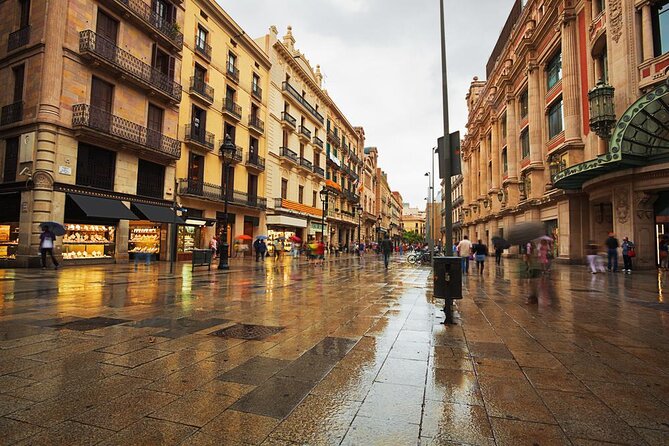
- Private pacing through Barcelona’s core: only your group, with the route planned as a coherent loop rather than random stops.
- Roman layers in plain sight: you’ll spot the city’s Roman presence, including a visible wall entrance and Roman columns.
- Big squares, real stories: Plaça del Rei, Pont del Bisbe, and Plaça Reial connect politics, legends, and design details.
- Jewish quarter to wartime scars: Call de Barcelona and Plaça de Sant Felip Neri bring the 20th-century story into the old town.
- Born’s market ruins end the tour: Mercat del Born’s underground remains are a memorable closer.
- Sweet finish option at Hofmann: you can cap the walk with dessert immediately at the end point.
Meeting point on Passeig de Gràcia: getting started without stress
You’ll start at Apple Passeig de Gràcia, at Pg. de Gràcia, 1 (in the Eixample). The start time is 4:00 pm, and the tour runs about 3 hours. I like that the meeting spot is easy to find, and it’s near public transportation, which matters because Barcelona’s old streets can be a little confusing if you’re not already oriented.
The tour is private, meaning it’s only for your group. That’s a big deal in a city like Barcelona, where old town crowds can make a group tour feel chaotic. With a private format, you can usually ask questions without trying to shout over the traffic.
This experience also uses a mobile ticket, which is convenient if you’re trying to keep your phone organized and your wallet closed. Language is English, so you’ll get the story clearly without guessing.
Finally, the price is $180.04 per person. That’s not a cheap casual walk, but it can feel fair for a private 3-hour route that takes you through a dense cluster of major sights with guided context. It tends to be best value if you’re traveling as a small group and want a “see the core” plan without building it yourself.
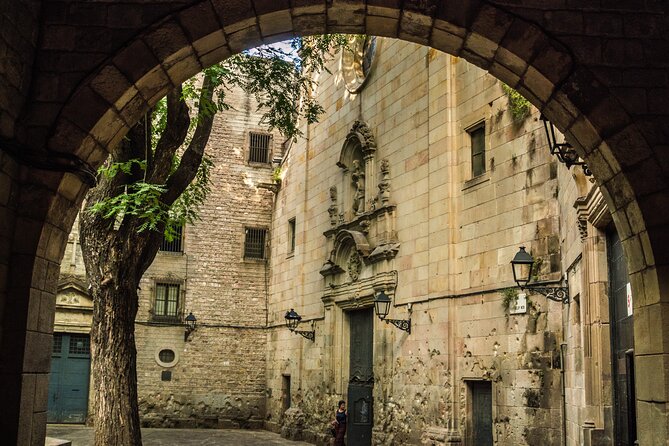
Deeper into the lanes of the Barri Gòtic


From Plaça de Catalunya to Las Ramblas: the city’s connector street
The tour begins in Plaça de Catalunya, Barcelona’s central crossroads. This is a smart first stop because it gives you a mental map. You get a briefing right where you can feel the city’s layout: Eixample to the north, the old town to the south.
Then you head to Las Ramblas, the famous boulevard that connects the newer parts of the city with the port. This street is noisy, crowded, and full of street-level life, but it’s also a shortcut to understanding how Barcelona grew from a compact center into a bigger city. At this point, your guide’s job is to help you look past the tourist bustle and start noticing the history threads.
You’ll also pass by the Font de Canaletes, a fountain tied to celebrations, including those associated with FC Barcelona triumphs. It’s a small stop, but it’s useful because it shows how local pride and identity get woven into everyday landmarks.
One practical note: Las Ramblas can feel overwhelming if you’re sensitive to crowds. If that’s your thing, aim to keep your pace steady and let the guide carry you from one landmark to the next.
Boqueria, Petritxol, and Santa Maria del Pi: markets and old-town style
A highlight early on is Mercat de la Boqueria, one of Barcelona’s best-known markets. Even if you don’t plan to buy much, it’s worth seeing because it shows what “food culture” looks like when it’s woven into a historic street. You’ll get the market’s context without being forced into a shopping sprint.
From there, the walk shifts to Carrer de Petritxol, famous as the Street of Chocolate. This is one of those streets where the vibe is the point: narrow lanes, old-town feel, and storefronts that lean into the city’s sweet tooth.
Next is Basílica de Santa Maria del Pi. The basilica is a recognizable landmark, and this stop is short—good for quick orientation and exterior appreciation. Admission for this basilica is not included, so don’t count on getting inside unless you’re ready to pay separately if the timing works out.
If you want to get the most from this section, keep an eye out for how the architecture changes as you move from the more commercial streets into deeper Gothic territory. That shift is basically the tour’s theme.
Call de Barcelona and Plaça de Sant Felip Neri: where history shows through
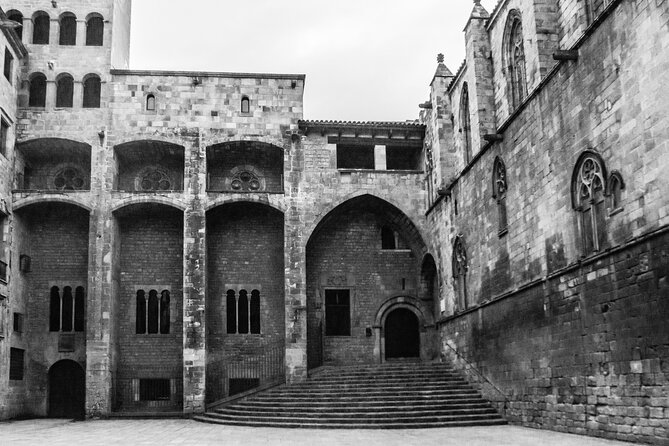
Once you leave the main “famous street” energy, you enter the quieter, more layered parts of the Gothic area. The tour takes you to Call de Barcelona, the Jewish area within the Gothic Quarter. This short stop matters because it adds a key chapter to the old town story—you’re not just looking at beautiful buildings, you’re tracking communities that shaped the city.
Then you reach Plaça de Sant Felip Neri, described as both beautiful and sadly famous. This square has traces connected to bombing in 1938, which pulls Barcelona into the context of 20th-century conflict. It’s one of the tour moments that feels heavier than a standard sightseeing walk, and it’s also exactly why guided storytelling works here: you notice more when you understand why a place looks the way it does.
The timing here is brief, but it’s long enough to change how you read the neighborhood. You start seeing the old town not just as a backdrop, but as something that survived real events.
Roman entrance to the Gothic power core: wall remnants, the Kiss, and the Cathedral
One of the most satisfying shifts on this tour is going from medieval-looking streets to Roman remnants. You’ll see the Roman city wall in Barcelona, including what’s described as the Roman entrance of the city. Even on a short stop, it helps you grasp that today’s Gothic streets are sitting on older layers—Barcelona didn’t start in the Middle Ages.
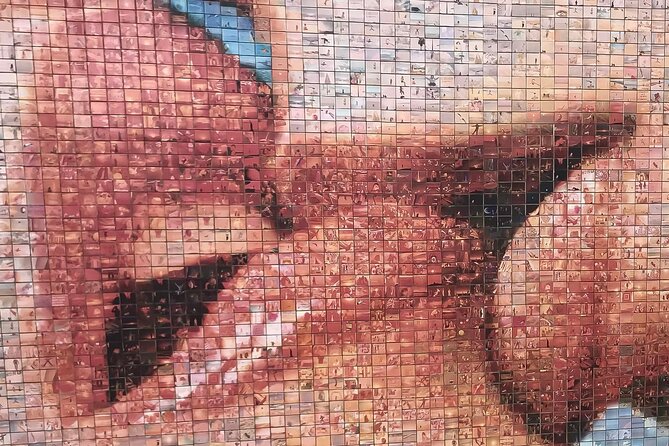
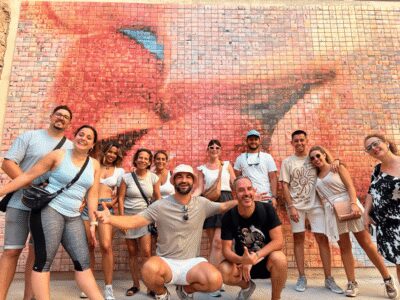
The walk then moves to Plaça d’Isidre Nonell, where you’ll see a mosaic connected to The Kiss. It’s quick, but it’s a clever palate cleanser between big architectural statements.
Next comes the Cathedral of Barcelona. This is a major sight in its own right, and the guided version is useful because it helps you know what you’re looking at rather than just photographing the facade. The stop is short, so don’t expect deep interior time—use it to reset your bearings and focus on the structure and setting.
After that, the tour goes to Plaça del Rei, a monumental square surrounded by Gothic and Renaissance buildings linked to the Royal Palace. This is one of the better places to understand Barcelona’s historic government center, since the space itself feels like an official stage rather than a typical neighborhood square.
More Barcelona streets to take slowly
- Barcelona Tapas and Wine Experience Small-Group Walking Tour★ 5.0 · 5,804 reviews
- Barcelona: Tapas Walking Tour with Food, Wine, and History★ 4.8 · 4,261 reviews
- Barcelona: Food Walking Tour with Tapas and Wine★ 4.9 · 2,180 reviews
MUHBA Roman ruins and the Temple of Augustus columns: what 2 minutes can teach
The tour includes a stop at MUHBA (Museu d’Historia de Barcelona), where there are about 4,000 m² of Roman ruins. Admission is not included, and the time here is short, but it’s still an effective nudge. If Roman Barcelona is the angle that hooks you, you’ll have a clear reason to plan a separate museum visit.
Right after, you’ll visit Centre Excursionista de Catalunya, known here for four Roman-period columns (linked to the Temple of Augustus). Seeing columns like this in the middle of city blocks is one of those Barcelona moments that makes the whole city feel like an archaeological layer cake.
This pair of stops is the tour’s “zoom in” on the Roman theme. You won’t get a full museum experience in 3 hours, but you’ll come away knowing where the Roman story is physically visible.
Pont del Bisbe and the power addresses: city hall, Generalitat, and legends
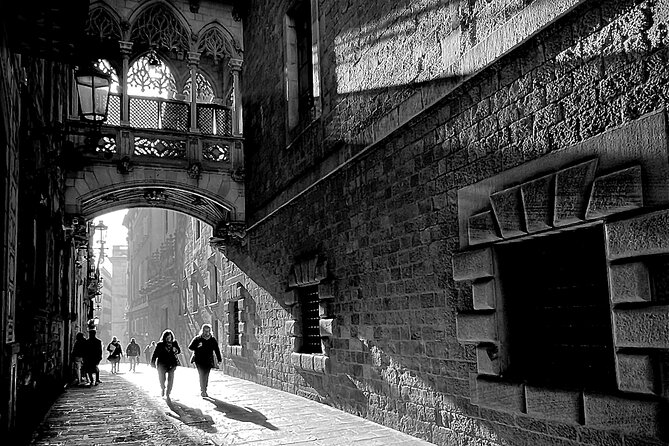
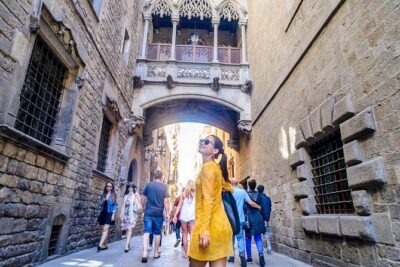
After the Roman and cathedral zone, the walk moves into political Barcelona. The tour includes Pont del Bisbe, one of the city’s most photographed bridges. Here you’ll get its secrets and legends, which is exactly the right way to treat a bridge like this. Instead of “look at the bridge,” you’re “look at the bridge and listen for why it became famous.”
Then you’ll pass by City Hall (Casa de la Ciutat / Ayuntamiento), followed by Palau de la Generalitat de Catalunya. These are short stops, but they connect the old town’s architecture to the idea of governance—who ruled, where decisions happened, and how power left a physical footprint.
If you like “why places matter,” this is a strong section. It’s easy to glide past official buildings without thinking. A guided walk gives you the context to notice the role they played.
Castellers, Plaça Reial, and Gaudí’s street lamps: Catalan traditions and design details
Next comes a shift from politics to culture. You’ll see a monument to Castellers—the human towers tradition. This isn’t just a statue moment. In Catalunya, human towers are serious community skill and identity, and a monument like this is a neat way to connect tradition to the city’s public spaces.
Then you reach Plaça Reial, a beautiful connector square between the Gothic area and Las Ramblas. A standout detail here is the mention of one of Antoni Gaudí’s very early works: the special street lamps. This matters because it ties the Gothic and royal-squares feel to the later modernist imagination that Barcelona is famous for.
After that, you’ll stop at Plaça de George Orwell and Plaça dels Traginers. The Traginers square includes mention of an old Roman tower. These are shorter, lower-pressure stops, but they add variety—less big-ticket, more “walk and discover.”
If you’re tired, this portion is also good because you get a few calmer moments between major architecture stops.
Santa Maria del Mar and the Born: an old market built into the ground
The tour reaches Basílica de Santa Maria del Mar next. It’s one of Barcelona’s most important basilicas, and depending on time, you may be able to go inside. Admission is listed as free, so this is one of the places where you might feel like the tour “levels up” beyond a street-only walk.
Then you move through Passeig del Born, a pleasant boulevard that helps shift you from the cathedral center into the Born neighborhood mood.
The closer that really lands is Mercat del Born, which is now a cultural center because of ruins from the XVIII century visible underneath. The fact that you can see the old structures below the market floor is a strong reminder that Barcelona keeps rebuilding over itself. It’s the kind of moment where you stop and look up and down at once.
If you like photographs, this is a great finale zone because the architecture, the underground remains, and the street atmosphere all feed each other.
Finishing at Hofmann: dessert as a plan, not an afterthought
At the end, you’ll walk to Patisserie Hofmann, listed as the finish point. This is set up as a sweet close: you can decide to have a drink nearby or go straight for dessert. It’s a smart finish because it gives you a built-in “what now” option when the tour ends, instead of standing around wondering where to go next.
I also like that this ending location keeps you in the Born area, where you’ll still have options for casual strolling after the guided part is done.
So, is it worth booking? (My practical take)
Book this private walk if you want a 3-hour orientation to Barcelona’s Old Town that actually connects the dots between places: Roman traces, Gothic power, Jewish area context, wartime scars, and Catalan tradition. It’s a great fit for first-timers who don’t want to spend days piecing together a route, and it’s a good fit if you like guided commentary more than museum time.
Skip or adjust expectations if you want long interior visits or a deep museum day. MUHBA has admission not included, and at other religious sites, the time window is short and interior access depends on timing. Also, the route includes highly trafficked streets like Las Ramblas, so if you hate crowds, wear comfortable shoes and keep your pace calm.
Overall, the value depends on your group. If you’re splitting costs with a small crew, the private format can feel like money well spent for what you see and how it’s explained.
FAQ
Is this tour private?
Yes. It is a private tour/activity, and only your group will participate.
How long is the Private Barcelona Old Town Walking Tour?
The duration is about 3 hours.
What time does the tour start?
The start time is 4:00 pm.
Where does the tour start and end?
It starts at Apple Passeig de Gràcia, Pg. de Gràcia, 1, Eixample, 08007 Barcelona, Spain. It ends at Mercat del Born, Plaça Comercial, 12, Ciutat Vella, 08003 Barcelona, Spain.
Is the tour offered in English?
Yes, it’s offered in English.
Are tickets and admissions included?
Many stops are listed as free, but some are not included. Admission is not included for Basílica de Santa Maria del Pi and Museu d’Historia de Barcelona (MUHBA).
What is the price per person?
The price is $180.04 per person.
Will I need a printed ticket?
No. The tour uses a mobile ticket.
Is free cancellation available?
Yes. You can cancel for a full refund up to 24 hours before the experience’s start time.
Are service animals allowed?
Yes, service animals are allowed.
More Ways to Tour Barcelona
- Barcelona: Casa Batlló Entry with Self-Audioguide Tour
★ 4.7 · 25,359 reviews - Barcelona: 24 or 48-Hour Hop-On Hop-Off Bus Tour
★ 4.4 · 20,872 reviews - Barcelona: Park Guell Guided Tour with Skip The Line Entry
★ 4.7 · 17,563 reviews - Barcelona: Sagrada Familia Skip-the-Line Entry Ticket & Tour
★ 4.8 · 12,789 reviews - Barcelona: FC Barcelona Museum “Barça Immersive Tour” Ticket
★ 4.4 · 10,944 reviews
More Barcelona Tours on Our Radar
- Barcelona: Sagrada Familia Entry Ticket with Audio Guide
★ 4.6 · 105,312 reviews - Barcelona: Park Güell Admission Ticket
★ 4.4 · 76,534 reviews - Barcelona: Casa Batlló Entry with Self-Audioguide Tour
★ 4.7 · 25,359 reviews - Barcelona: Montjuïc Cable Car Roundtrip Ticket
★ 4.5 · 22,368 reviews - Barcelona: Hola Barcelona Public Transport Travel Card
★ 4.5 · 20,985 reviews
Lost in the Gothic Quarter
- Barcelona in 1 Day: Sagrada Familia, Park Guell,Old Town & Pickup
★ 5.0 · 13,541 reviews - Barcelona all included: Sagrada, Park Güell, Montjuic & Gothic
★ 5.0 · 2,169 reviews - Barcelona: Sagrada Familia, Modernism, and Old Town Tour
★ 4.7 · 1,621 reviews - Barcelona Gothic Quarter Tapas & Taverns Food & Wine Tour
★ 5.0 · 1,470 reviews - Barcelona Helicopter, Sailboat & Old Town Private Walking Tour
★ 5.0 · 1,395 reviews
Just Rated Around Barcelona





Gothic Quarter Tours, compared.
 ★ 5.0Barcelona in 1 Day: Sagrada Familia, Park Guell,Old Town & PickupFrom $12013,541 reviews
 ★ 5.0Barcelona all included: Sagrada, Park Güell, Montjuic & GothicFrom $1192,169 reviews
 ★ 4.7Sagrada Familia, Modernism, and Old Town TourFrom $521,621 reviews
 ★ 5.0Barcelona Gothic Quarter Tapas & Taverns Food & Wine TourFrom $1311,470 reviews
 ★ 5.0Barcelona Helicopter, Sailboat & Old Town Private Walking TourFrom $5131,395 reviews
 ★ 4.8Old Town and Gothic Quarter Walking TourFrom $211,393 reviews
 ★ 4.7Helicopter, Boat Ride & Old Town Private TourFrom $5001,357 reviews
 ★ 5.0Barcelona Old Town & Gothic Quarter Small Group TourFrom $221,308 reviews
Browse the lists this tour appears in