
Reviewed · SKIP THE LINE
Sant Pau Art Nouveau Site Skip The Line | Sant Pau Hospital
Sant Pau in Barcelona is one of those sights that feels quietly magical the moment you step inside. I especially loved the skip-the-line entry, which keeps your visit from turning into a waiting game, and the chance to wander through photo-worthy Art Nouveau pavilions with stained glass, domes, and tiled details everywhere you look. The whole complex has that patient-centered idea behind it, not just an artsy facade.
One thing to consider: this ticket covers admission, not a guided tour. If you really want the medical-history storytelling (the kind that makes the place click fast), you may prefer to add a guide or bring your own curiosity and questions.
In This Review
- Key things to know before you go
- Why Sant Pau feels different from other Barcelona sights
- Skip-the-line entry: how to make 1–2 hours count
- Recinte Modernista de Sant Pau: pavilions, domes, and stained glass
- A hospital designed for healing, not just architecture
- Underground tunnels: the part that surprises people
- Gardens and quiet corners you’ll actually use
- Price and value: what $26.41 gets you
- Photography and crowd control: why people leave happy
- Getting the most out of your visit (without overplanning)
- Who should book this, and who might want a different plan
- Should you book Sant Pau skip-the-line admission?
- FAQ
- What is included in the Sant Pau skip-the-line ticket?
- How long should I plan for my visit?
- Where is the experience located?
- Who designed the Sant Pau complex?
- What years were the Art Nouveau hospital buildings constructed?
- Is Sant Pau a UNESCO World Heritage Site?
- What can I see during the visit?
- Is a guided tour included with the ticket?
- When will I receive confirmation after booking?
- What is the cancellation policy?
Key things to know before you go
- Skip-the-line admission helps you start seeing the complex sooner, without queue stress
- Art Nouveau architecture by Lluís Domènech i Montaner, built 1901–1930
- 16 pavilions and restored spaces that feel big, not cramped
- Gardens meant for tranquillity, designed to support patients’ wellbeing
- Underground tunnels you won’t get to see at most Barcelona attractions
- UNESCO World Heritage status since 1997 (and it shows)
Why Sant Pau feels different from other Barcelona sights
Sant Pau Hospital doesn’t play the same game as the city’s headline attractions. Yes, it’s beautiful—very beautiful—but the bigger reason it lands with people is that it was built for a purpose. The design was meant to aid patients’ healing, and you can feel that calmer rhythm in the gardens and walkways.
There’s also a strong sense of continuity. The site’s roots go back to 1401, even though the Art Nouveau hospital complex that most visitors come for took shape from 1901 to 1930 under architect Lluís Domènech i Montaner. And since it’s been a UNESCO World Heritage Site since 1997, you’re not just touring a pretty building—you’re stepping into something preserved for a reason.
In practice, this means you’re not rushing from one landmark to another. You’re allowed to slow down, look closely, and take your time with the details—especially if you like architecture that rewards standing still for a minute.
Not quite right? Other Barcelona tours we have been out on




Skip-the-line entry: how to make 1–2 hours count
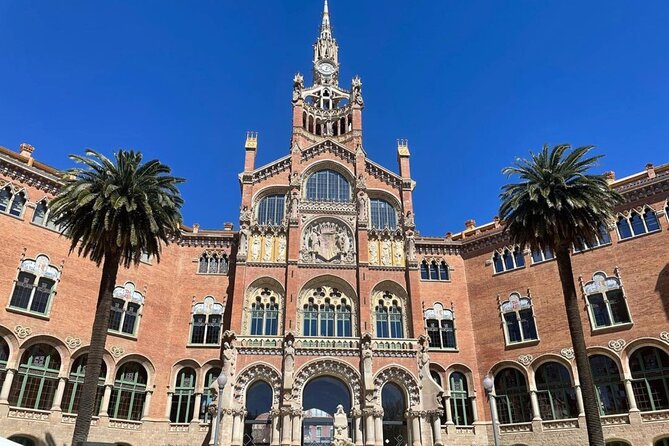
The ticket is timed by experience duration: plan on about 1 to 2 hours. That range matters, because Sant Pau is expansive and made of multiple pavilions, gardens, and connecting spaces. If you only have an hour, you’ll want to choose your priorities quickly—architecture close-ups, gardens, and at least part of the tunnel/underground areas.
The good news is that the skip-the-line feature is genuinely useful here. One of the most consistent themes in feedback is that people could get in fast, take pictures without endless crowd interruptions, and stroll without the usual squeeze. Even if you’re traveling in high season, Sant Pau tends to feel more walkable than some of Barcelona’s biggest bottlenecks.
Quick timing tip that works: go in with a small checklist. For example: stained glass, one dome/roof detail, the garden moment, and a stop or two underground. If you do that, you’ll leave satisfied even if you don’t see every corner.
Recinte Modernista de Sant Pau: pavilions, domes, and stained glass
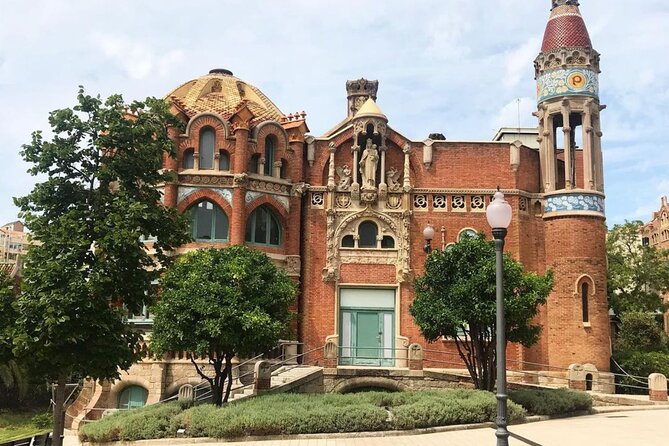
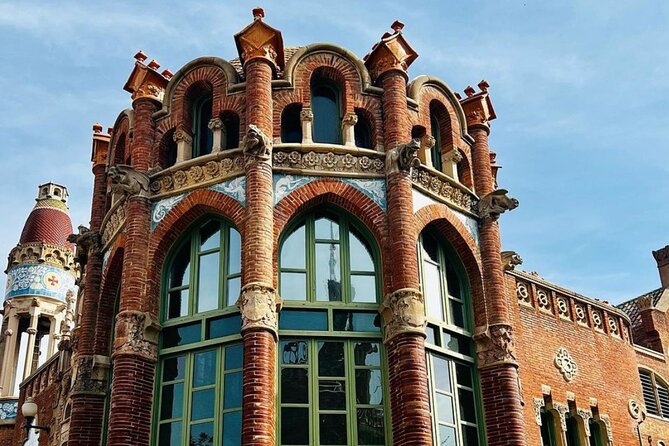
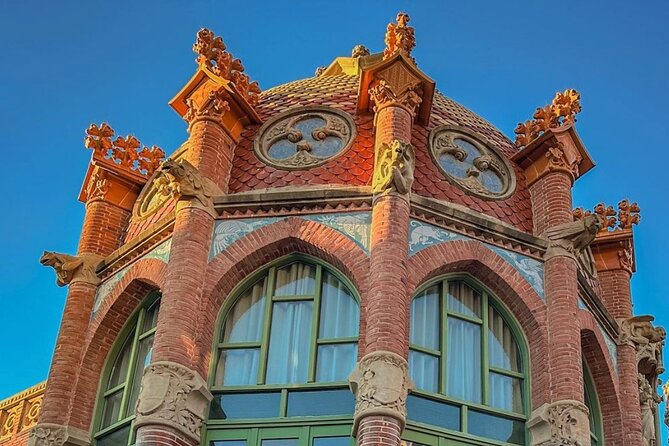
The heart of the visit is the modernist complex itself—the Recinte Modernista de Sant Pau—with 16 pavilions spread across the property. What makes it special is how much design you can see from almost any angle: domes, tiled turrets, rooftop shapes, mosaics, and stained glass. This is Catalan Art Nouveau at full volume.
You’ll also notice how joyful the architecture feels. That’s not an accident. The complex was designed to be more than functional space, and the overall layout is built for light and wellbeing. In visitor descriptions, people repeatedly mention that it feels like a place meant for calm—not a cold institutional site.
If you’re a photography person, this is one of those rare places where the building keeps giving you fresh frames. It’s not just one photo spot. You can take a few steps and find another color pattern, another glass panel, another dome rhythm. Stained glass gets special attention, and it’s easy to see why when sunlight hits those surfaces and the colors shift.
One practical consideration: because the site is made up of many connected buildings, you should expect walking between points of interest. Wear comfortable shoes, and don’t try to speed-run it like you’re touring a museum in “cover-to-cover mode.”
A hospital designed for healing, not just architecture
The most meaningful part of Sant Pau is the idea behind it. The complex was built to help patients heal, and the design focuses on tranquillity. When you sit or pause in the gardens, it makes more sense why the hospital would prioritize calm surroundings alongside medical function.
You’ll also get the sense that the hospital evolved over time. The site began in 1401, and then the modernist redevelopment between 1901 and 1930 created a campus-style hospital complex that lasted well into the modern era. Some visitor notes point out that Sant Pau operated as a municipal hospital for many decades, until 2009, before the restored complex became a major cultural site.
This is where the optional guided tour decision comes in. Since the ticket includes entry but not a guide, you’ll want to be proactive about learning as you go. If you care about the “why” behind the spaces—the layout, the patient-centered calm, the original mission—booking a guided experience can make your time feel more complete.
Still, even without a guide, the building communicates its intent. You’ll see it in the way the pavilions relate to each other and in how the gardens act like recovery space, not dead landscaping.
Underground tunnels: the part that surprises people
One of the highlights is access to underground tunnels. This is the kind of feature that turns a standard architecture visit into something more like exploring a functioning complex—just preserved and restored.
It’s also a great contrast with the open pavilions above. You go from colorful, bright exterior details to more sheltered underground spaces. Even if you’re not a “historic engineering” person, the tunnels add variety and help you understand that the complex wasn’t designed as separate buildings only—it was designed as a connected whole.
Photo tip: tunnel lighting can vary, so don’t rely on one shot. Take a couple frames at different angles, and give your eyes a moment to adjust before you decide what’s worth photographing.
- Barcelona: Hola Barcelona Public Transport Travel Card★ 4.5 · 20,985 reviews
- Barcelona: 24 or 48-Hour Hop-On Hop-Off Bus Tour★ 4.4 · 20,872 reviews
- Barcelona: Park Guell Guided Tour with Skip The Line Entry★ 4.7 · 17,563 reviews
Gardens and quiet corners you’ll actually use
The gardens are not filler. They’re a core part of why Sant Pau feels different. Many people mention stopping to relax and taking in the atmosphere the architect intended for patients in the early 20th century.
This matters for your experience because Barcelona can be loud. If you’re doing Sagrada Família, Gaudí, crowds, and heat, Sant Pau offers a reset. It’s a place where you can slow your pace, look around without being jostled, and recharge before your next stop.
You don’t need to be a “garden lover” to appreciate this. Even a quick pause—standing still for a minute, looking at glass, listening to the sense of space—helps the whole visit click. The gardens give context to why the hospital campus design was built the way it was.
Price and value: what $26.41 gets you
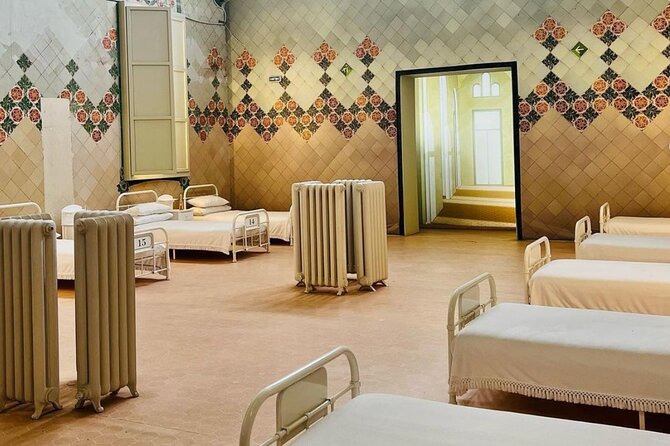
At $26.41 per person with admission included, the value depends on what you want from the visit.
You’re paying for:
- Skip-the-line entry
- Access to the venue spaces, including the architectural pavilions and the underground tunnels
You’re not paying for:
- A guided tour (the ticket includes admission only)
So here’s the honest way to judge value. If you want a self-paced stroll where you can take photos, admire stained glass and domes, and enjoy the calm garden atmosphere, this can be a strong deal. Multiple reviews praise the lack of queue pressure and the freedom to explore at a relaxed tempo.
If you want deep historical narration—especially on the patient-healing design concept—this price may feel incomplete. In one review, someone strongly recommended a guided tour because the history is stunning. That’s a good clue: if you’re the type who reads every plaque slowly and loves context, you might get even more out of your time with a guide.
Photography and crowd control: why people leave happy
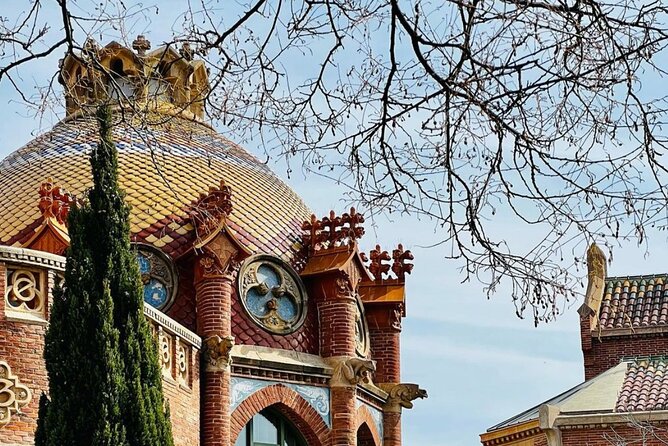
A lot of visitors come to Barcelona for iconic structures, and many leave feeling like their pictures were taken through someone else’s shoulder. Sant Pau changes that vibe. One person specifically highlighted that they didn’t have to queue much, could take pictures without endless photobombing, and could explore freely.
Even if crowd levels vary day to day, the complex’s layout supports a calmer flow. You’re not funnelled into a single hallway. You’re moving between pavilions and open areas, which helps the experience feel less like a conveyor belt.
If photography is a priority for you, do this: don’t spend all your first 20 minutes shooting exteriors only. Plan to also photograph stained glass and interior details when you get the chance. That’s where the visual payoff really stacks up—especially for close-up color and pattern.
Getting the most out of your visit (without overplanning)
Sant Pau works best when you give it room. With 1–2 hours, don’t try to “check off” every single detail like a scavenger hunt. Instead, focus on a few strong moments:
- A pavilion exterior with dome/turret detail
- Stained glass moments
- A quiet garden pause
- At least part of the underground tunnel experience
This approach also helps if you’re traveling with kids or friends who don’t want a lecture. You’ll still find plenty to look at, and you can keep the visit moving at a human pace.
Also, don’t worry if you’re not an Art Nouveau expert. You can enjoy the place simply by noticing the craftsmanship and the way the buildings communicate calm and care. Reviews mention people being impressed by how much Art Nouveau style appears across the complex, and even non-experts can appreciate that instantly.
Who should book this, and who might want a different plan
Book this if:
- You love Art Nouveau / modernist architecture and want something beyond Gaudí’s most famous sites
- You want a calmer Barcelona stop with gardens and patient-centered design
- You like photography—Sant Pau gives you tons of detail angles
- You’re interested in a hospital site with a long timeline, including the 1401 origins and the 1901–1930 redevelopment era
You might choose something else if:
- You mainly want a fully narrated history experience, because this ticket is admission only
- You’re looking for a very short, high-energy attraction. Sant Pau is worth slowing down for.
Should you book Sant Pau skip-the-line admission?
If your goal is a self-paced, architecture-first visit that includes skip-the-line entry, this is an easy recommendation. At $26.41, you’re getting access to a UNESCO-listed modernist hospital campus, with gardens, stained glass, multiple pavilions, and even underground tunnels—all in a time window that fits comfortably into a Barcelona itinerary.
I’d only hesitate if you know you’ll feel lost without a guide. Since the ticket doesn’t include guided interpretation, history lovers may prefer adding a tour. But for most people who want to stroll, look closely, and take pictures in a calmer setting, Sant Pau is the kind of ticket that feels worth it from minute one.
FAQ
What is included in the Sant Pau skip-the-line ticket?
The ticket includes admission to the venue. A guided tour is not included.
How long should I plan for my visit?
Plan for about 1 to 2 hours.
Where is the experience located?
It’s in Barcelona, Spain, at the Sant Pau Art Nouveau Site (Recinte Modernista de Sant Pau).
Who designed the Sant Pau complex?
The complex is associated with architect Lluís Domènech i Montaner.
What years were the Art Nouveau hospital buildings constructed?
The buildings were built between 1901 and 1930.
Is Sant Pau a UNESCO World Heritage Site?
Yes. It has been a UNESCO World Heritage Site since 1997.
What can I see during the visit?
You can explore the property with multiple pavilions, gardens, and underground tunnels, plus Art Nouveau architectural details like domes and stained glass.
Is a guided tour included with the ticket?
No. Admission is included, but a guided tour is not.
When will I receive confirmation after booking?
Confirmation is received within 48 hours of booking, subject to availability.
What is the cancellation policy?
The experience is non-refundable and cannot be changed for any reason.
More Skip the Line in Barcelona
- Barcelona: Park Guell Guided Tour with Skip The Line Entry
★ 4.7 · 17,563 reviews - Barcelona: Sagrada Familia Skip-the-Line Entry Ticket & Tour
★ 4.8 · 12,789 reviews - Park Guell Guided Tour with Skip the Line Ticket
★ 4.5 · 6,996 reviews - Park Guell and Sagrada Familia Tour with Skip the Line Tickets
★ 5.0 · 6,384 reviews - Barcelona: Sagrada Familia Skip-the-Line Guided Tour
★ 4.3 · 5,365 reviews
More Barcelona Tours on Our Radar
- Barcelona: Sagrada Familia Entry Ticket with Audio Guide
★ 4.6 · 105,312 reviews - Barcelona: Park Güell Admission Ticket
★ 4.4 · 76,534 reviews - Barcelona: Casa Batlló Entry with Self-Audioguide Tour
★ 4.7 · 25,359 reviews - Barcelona: Montjuïc Cable Car Roundtrip Ticket
★ 4.5 · 22,368 reviews - Barcelona: Hola Barcelona Public Transport Travel Card
★ 4.5 · 20,985 reviews
Just Rated Around Barcelona





Skip the Line, compared.
 ★ 4.7Park Guell Guided Tour with Skip The Line EntryFrom $3117,563 reviews
 ★ 4.8Sagrada Familia Skip-the-Line Entry Ticket & TourFrom $6712,789 reviews
 ★ 4.5Park Guell Guided Tour with Skip the Line TicketFrom $386,996 reviews
 ★ 5.0Park Guell and Sagrada Familia Tour with Skip the Line TicketsFrom $1196,384 reviews
 ★ 4.3Sagrada Familia Skip-the-Line Guided TourFrom $655,365 reviews
★ 4.8Sagrada Familia Skip-the-Line Guided TourFrom $643,824 reviews
★ 4.3Sagrada Familia Skip-the-Line Guided TourFrom $655,365 reviews
★ 4.8Sagrada Familia Skip-the-Line Guided TourFrom $643,824 reviews
 ★ 4.7Sagrada Família Skip the Line Tour & Entry TicketFrom $633,528 reviews
 ★ 4.5Picasso Museum Skip-the-Line Guided TourFrom $443,355 reviews