
Reviewed · GOTHIC QUARTER TOURS
Barcelona Gothic Quarter History Tour
Roman ruins meet Catalan Gothic in 2 hours. This Barcelona Gothic Quarter history tour stitches together the city’s layers fast, from a Roman cemetery site to the Catalan Gothic around Plaça del Pi and Barcelona Cathedral. I especially like the small group size (max 8) and the way guide Andrea explains what you’re looking at in plain language, with room for questions.
My only real caution is timing. The tour starts at 4:00 pm and runs about 2 hours, so if you’re trying to pack in late-afternoon plans elsewhere, leave some buffer for short walks between stops and the group pace.
In This Review
- Key highlights to look for
- Price and what you actually get for $57.99
- Where the tour starts in Ciutat Vella, and where you end at Plaça Reial
- Roman Barcelona you can’t see unless someone points it out: MUHBA Via Sepulcral Romana
- Catalan Gothic at Plaça del Pi and the stories behind Santa María del Pi
- Barcelona Cathedral: learning to read the façade and the timeline
- Placa del Rei: Roman roots, the Crown of Aragon, and the inquisition
- MUHBA Temple d’August: the Roman Forum connection
- Plaça Sant Felip Neri and Spanish Civil War memory
- Catalan Judaism: another layer of identity in the same streets
- Plaça Reial finish: the 200-year-old shop and where to go next
- Group size, language, and why Andrea’s approach matters
- Weather and timing: when to book and what to watch
- Who this tour suits best
- Should you book the Barcelona Gothic Quarter History Tour?
- FAQ
- FAQ
- What time does the Barcelona Gothic Quarter History Tour start?
- How long is the tour, and is it a small group?
- Is the tour offered in English?
- Where do I meet the guide, and where does the tour end?
- Are there extra admission costs at the stops?
- What happens if the weather is bad or I need to cancel?
Key highlights to look for
- A Roman-to-medieval storyline you can follow on foot through multiple key squares and sites
- MUHBA sites (including Via Sepulcral Romana and Temple d’August) that connect Barcelona’s ancient roots
- Plaça del Pi and Santa María del Pi: Catalan Gothic details plus Petrixol street context
- Placa del Rei: a focused stop on the Roman past, the Crown of Aragon, and the inquisition
- Plaça Sant Felip Neri: a shift to the Spanish Civil War and how newer history sits inside older streets
- End at Plaça Reial: finish at a lively plaza tied to a centuries-old shop
Price and what you actually get for $57.99
At $57.99 per person for roughly two hours, the value here comes from how much ground the route covers and how tightly it’s structured. You’re not just told stories from the sidewalk. The itinerary moves you through a set of specific Barcelona landmarks, with multiple short stops that typically range from about 5 to 15 minutes.
What helps the price make sense: the tour includes all fees and taxes, and it uses a mobile ticket. Each listed stop notes admission ticket free, which means you’re not constantly thinking about extra entry costs while trying to enjoy the walk and the explanations.
Group size also matters. With a maximum of 8 travelers, you get more attention than on big coach tours. That shows in how the guide handles details and questions, and it’s also how you avoid the usual problem: you look at a building, but you never learn what to notice.
One more small point that affects value: the tour is offered in English, and the in-person guide is listed as English and Spanish. If you’re comfortable in either language, you’re set up for a smoother experience even when the guide answers questions on the fly.
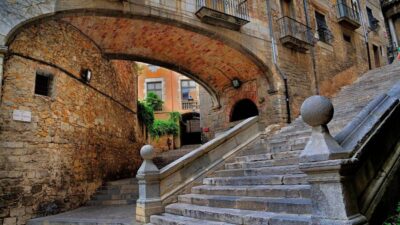
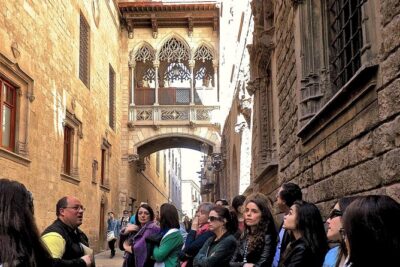
Deeper into the lanes of the Barri Gòtic
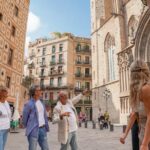


Where the tour starts in Ciutat Vella, and where you end at Plaça Reial
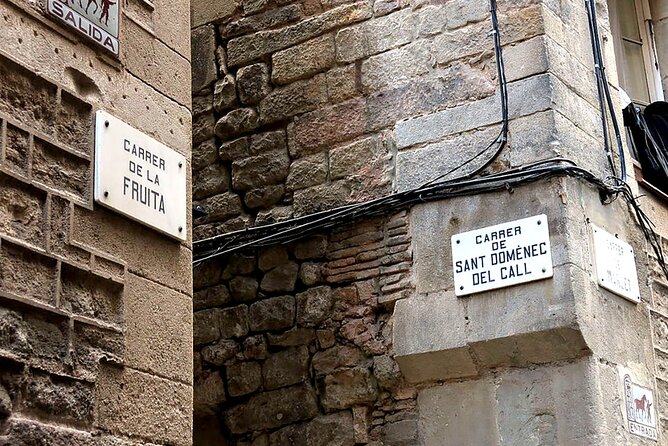
The meeting point is Carrer de Duran i Bas, 11, Ciutat Vella (08002), and the tour ends at Plaça Reial (Pl. Reial, Ciutat Vella, 08002). That end point isn’t random. Plaça Reial is one of those places you’ll want to linger after a history walk, because you can keep the evening going right where the tour finishes.
The start time is 4:00 pm, which I like for two reasons. First, it’s late enough that you can settle into your day, especially if you arrive mid-afternoon. Second, you avoid the first-morning crush that often hits popular old-town sites.
Also useful: the tour is described as near public transportation. That matters in Barcelona, where getting from neighborhood to neighborhood can be faster than people expect if you’re close to lines and stops.
Finally, service animals are allowed, and the tour says most travelers can participate. If you’re picking this as your main Gothic Quarter introduction, you’re not signing up for a niche, hard-to-access route.
Roman Barcelona you can’t see unless someone points it out: MUHBA Via Sepulcral Romana
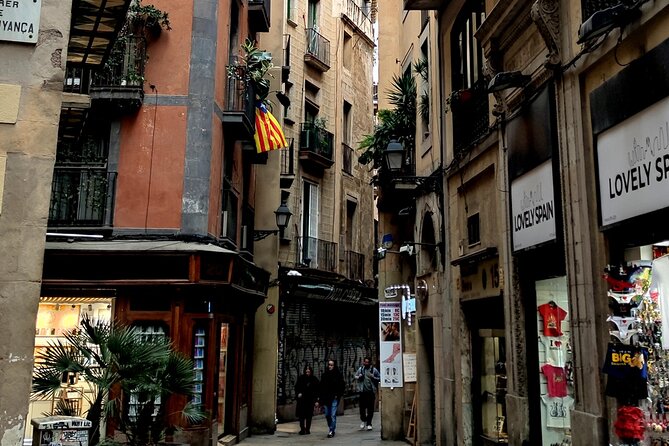
The tour begins with MUHBA Via Sepulcral Romana, described as an old Roman cemetery. This is the kind of stop that makes a history tour feel real, because Roman Barcelona isn’t just “ancient stuff somewhere else.” It’s part of the ground-floor story of this neighborhood.
Even if you think you know the Gothic Quarter, Roman remains are easy to miss when you only focus on cathedrals and medieval plazas. This stop gives you a way to look at Barcelona like a layered city: streets, stones, and sites from different eras sharing the same small area.
What I’d watch for here is the guide’s linking: how a cemetery site connects to where people lived, how communities organized space, and why later eras built over earlier ones. The duration is short (listed at about 5 minutes), but it’s set up to give you a concrete “anchor” before the tour moves into medieval Gothic.
A practical consideration: because this is an early stop in a compact schedule, show up on time. If you’re late, you may lose the first thread the guide uses to connect the rest of the route.
Catalan Gothic at Plaça del Pi and the stories behind Santa María del Pi
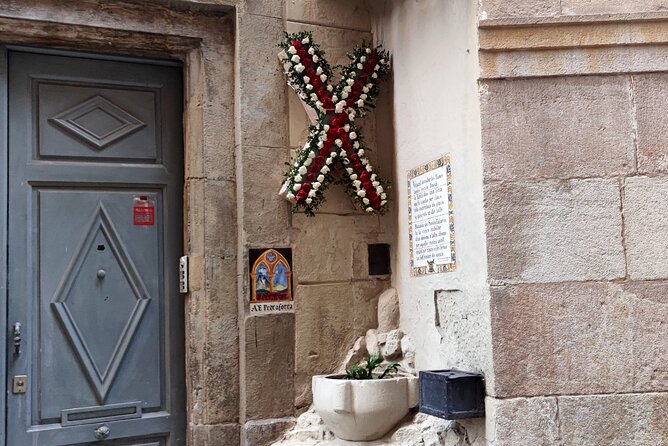
Next is Plaça del Pi, with a focus on Catalan Gothic and Santa María del Pi, plus the “treasures” of Petrixol street. This is where the tour shifts from Roman anchors into Barcelona’s signature medieval look.
Plaça del Pi is a practical stop for learning because it’s open enough to orient yourself, but still close to the details you’d miss if you just wandered. The guide can point out how Catalan Gothic differs from the Gothic you might associate with other European cities, and what to look for on the church and surrounding street patterns.
Then comes the mention of Petrixol street. Even if you’ve heard of it as a charming old lane, the tour frames it as part of the Gothic Quarter’s story, not just a photo spot. You’ll get context on why these streets became known, how they fit with the neighborhood’s shape, and why the area feels like it does today.
This segment lasts about 15 minutes, which is the sweet spot for a neighborhood stop: long enough to absorb details and short enough to keep the momentum.
Barcelona Cathedral: learning to read the façade and the timeline
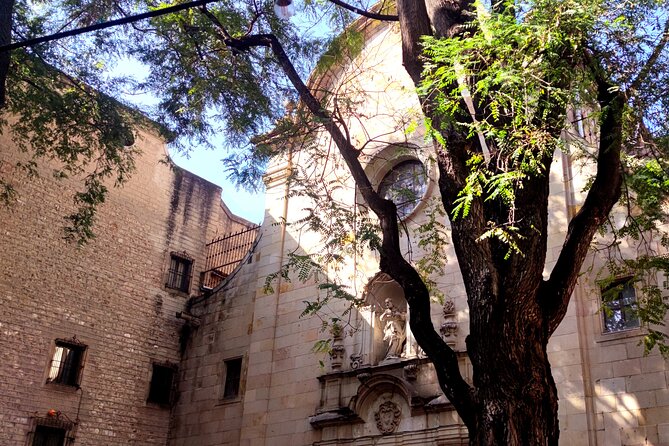
The tour includes Barcelona Cathedral as the next major moment. You’ll get a guided explanation of the history of the Cathedral of Barcelona for about 10 minutes.
For me, cathedral stops on tours work when the guide does two things:
1) connects the building to the city’s power and belief systems, and
2) teaches you what to notice so you can keep seeing after the tour ends.
Even in a short time window, the cathedral can do both, because it’s such a visual landmark. Once you understand what the guide emphasizes—how the site developed over time, and why certain elements matter—you start seeing the building as a timeline rather than a single “pretty big church.”
One drawback to consider: ten minutes can’t cover every architectural chapter. If you love architectural deep research, you’ll likely want to follow up on your own after. But for a first-pass orientation to Barcelona’s cathedral story, it’s a strong, efficient stop.
More of the old Barcelona to walk
- Barcelona: Tapas Walking Tour with Food, Wine, and History★ 4.8 · 4,261 reviews
- Barcelona Tapas Walking Tour: Food, Wine & History★ 4.5 · 1,928 reviews
- Barcelona: 2.5-Hour Bike or E-Bike Historical Tour★ 4.5 · 1,262 reviews
Placa del Rei: Roman roots, the Crown of Aragon, and the inquisition
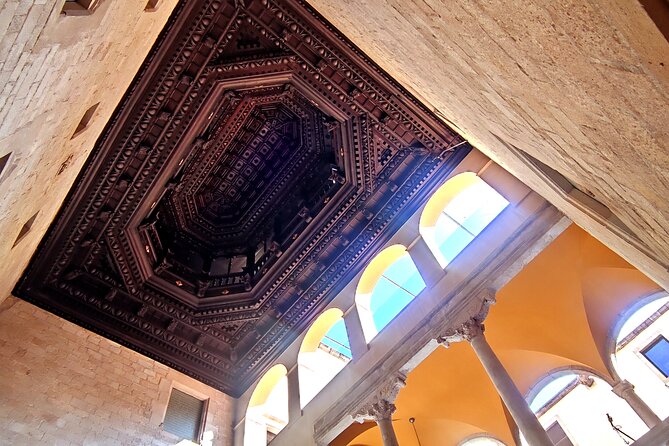
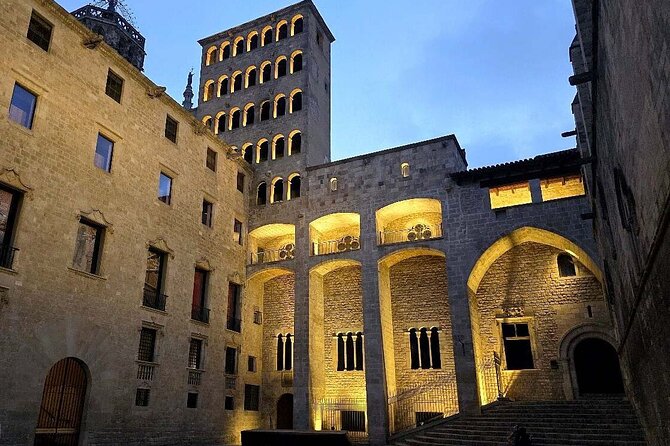
Placa del Rei is listed as a 15-minute stop focused on the Roman past, the Crown of Aragon, and the inquisition. This is a big shift in tone, and it’s one reason this tour feels more than a postcard walk.
Placa del Rei matters because it sits at the crossroads of different layers of authority. The Roman past is the foundation story. The Crown of Aragon brings the medieval political identity. Then the inquisition adds a darker, complicated chapter—something you need to face if you’re learning how power, religion, and law shaped real lives.
If you’re the type who likes history with consequences—who cares what different institutions meant for ordinary people—this is a standout segment. It also gives your tour a “why this place was important” spine, which makes the later stops feel connected instead of random.
This portion of the route may feel heavier than the more architectural stops. If you prefer lighter city stories, you might want to pace yourself and listen selectively—but the value here is that you get the full spectrum of Barcelona’s old layers, including the uncomfortable parts.
MUHBA Temple d’August: the Roman Forum connection
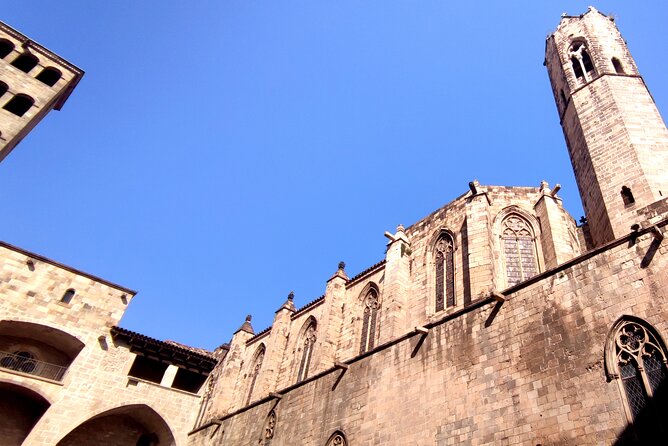
Then you move to MUHBA Temple d’August, described as a temple that was part of the Roman Forum, for about 10 minutes.
This stop is valuable because it helps you reframe what “Roman Barcelona” means. A Roman cemetery gets you one piece of the ancient picture. A forum-area temple adds another: public life, civic identity, and the space where politics and society met.
I like the way this tour pairs Roman sites close together. If you were doing it alone, you might bounce between attractions without making a clear mental map. With the guide, the route nudges you toward a simpler understanding: ancient Barcelona had a civic core, and later eras built their streets and meanings around it.
Short time reminder: it’s only listed at ten minutes. The goal is orientation, not an encyclopedia. You should leave knowing what the site was and why it mattered, so you can keep the forum idea in mind when you walk nearby streets on your own later.
Plaça Sant Felip Neri and Spanish Civil War memory
The tour stops at Placa Sant Felip Neri, with a 10-minute segment about the Spanish Civil War. This is where the tour shows you that “old town” isn’t only ancient and medieval.
The Gothic Quarter area can feel like it belongs entirely to medieval Europe, but Barcelona’s modern past sits right in the same streets. A focused stop like this helps you understand that the neighborhood’s meaning keeps changing, and history doesn’t stop at the Middle Ages.
What you’ll likely take away is a sense of how places become memory containers: squares and churches become markers of events, even when the architecture looks timeless at first glance.
If you’re sensitive to heavy topics, this is the part that may hit hardest. But from a travel perspective, it’s also the part that makes the Gothic Quarter feel like a living city, not just a museum of stone.
Catalan Judaism: another layer of identity in the same streets
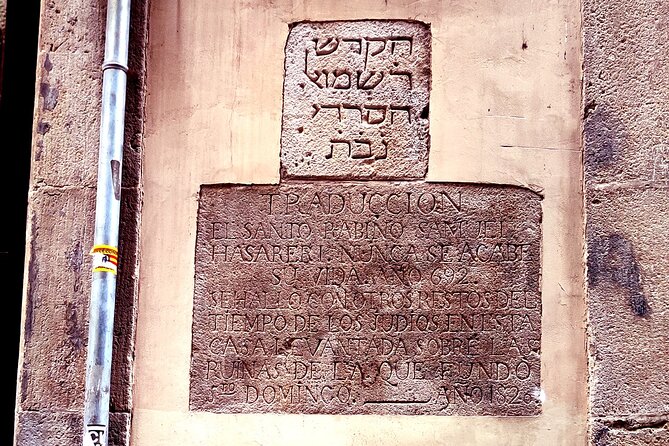
After Plaça Sant Felip Neri, the tour notes it will talk about Catalan Judaism. The itinerary doesn’t list a named exact point for that segment in the information provided, but it signals that the route includes a story about Jewish life in Catalonia and how that community fits into Barcelona’s broader past.
This is an important inclusion because it pushes beyond the most commonly highlighted themes (cathedrals, kings, and Roman remains). Instead, it addresses identity and community history, which is often what makes a guided tour feel thoughtful.
Practical tip: when the guide reaches this portion, pay attention to how they connect it to the streets you’re standing near. With old neighborhoods, the details matter. Small changes in geography can reflect big changes in community life over time.
Plaça Reial finish: the 200-year-old shop and where to go next
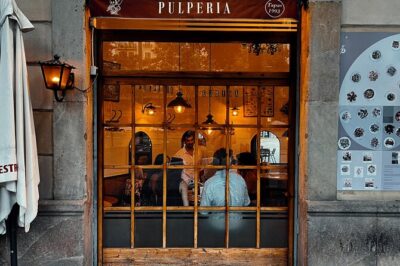
The tour ends at Plaça Reial, listed as a 10-minute final stop. The theme here is the plaza’s history plus discovering a 200-year-old shop.
Ending at Plaça Reial works because it’s a real-life place to land after two hours of explanation. You’ve seen Roman anchors, medieval churches, civic power, and 20th-century memory. Then the tour closes with a softer focus on the plaza itself and the kind of longtime commerce that keeps old-town districts functioning.
From a planning standpoint, I like this finish for dinner strategy. If you’re hungry, you’re already in a built-up area where you can keep moving without doubling back across Ciutat Vella.
And if you’re the type who enjoys seeing how history continues in modern street life, the “200-year-old shop” note is a reminder that the Gothic Quarter isn’t frozen. It’s still used.
Group size, language, and why Andrea’s approach matters
This experience caps at 8 travelers, and it’s guided in English. The guide is listed as in-person: English, Spanish, so if you speak Spanish or want to follow along that way, there’s flexibility.
In the reviews, the standout theme is the guide’s energy and ability to explain clearly without rushing people. Andrea is repeatedly credited with enthusiasm, patience, and picking out details you would likely miss on a larger group tour.
That matters because the Gothic Quarter can be confusing at ground level. Streets curve, plazas open suddenly, and you can walk past a building without realizing it’s the “chapter” the story is built around. A patient guide helps you connect the dots.
One more review-based detail you should expect: there are delightful bites included. That’s not a minor perk. A short history route can feel long if you’re hungry, and a few small treats keep the experience feeling human instead of like a lecture.
Weather and timing: when to book and what to watch
This tour says it requires good weather. If it’s canceled due to poor weather, you’ll be offered a different date or a full refund.
Given the start time is 4:00 pm, you’re also making a time-based bet. If you’re visiting Barcelona during a period known for storms, it’s smart to choose dates with at least some flexibility.
Because the stops are short and the schedule is tight (about 2 hours total), you’ll want to plan around it rather than hoping to squeeze it into the middle of another timed event. The endpoint at Plaça Reial also suggests an easy follow-on plan: stay in that area after the tour instead of jumping across town immediately.
Who this tour suits best
I think this tour is a great fit if you:
- want a fast, structured orientation to the Gothic Quarter
- like seeing Barcelona’s story jump from Roman to Gothic to modern memory
- prefer a smaller group where you can actually hear the explanation and ask questions
- are okay with a short format that prioritizes the main storyline over exhaustive detail
If you want hours and hours in one cathedral or one museum, you might prefer a longer dedicated site visit. But if you want the neighborhood to make sense quickly, this route does the job.
Should you book the Barcelona Gothic Quarter History Tour?
Book it if you want a guided walk with a clear narrative: Roman remains, Catalan Gothic landmarks, civic power in Placa del Rei, a Temple d’August stop, Civil War memory at Plaça Sant Felip Neri, and a finish at Plaça Reial. The price feels fair when you factor in the included fees and taxes, the admission ticket free notes for the stops, the small group limit, and the guide’s ability to make you see details instead of just passing by them.
Skip it only if you dislike heavier historical topics like the inquisition and the Spanish Civil War, or if you need a very long, slow-paced deep-dive at one site.
FAQ
FAQ
What time does the Barcelona Gothic Quarter History Tour start?
It starts at 4:00 pm and runs for about 2 hours.
How long is the tour, and is it a small group?
The tour lasts about 2 hours and has a maximum of 8 travelers.
Is the tour offered in English?
Yes. The tour is offered in English, and the guide is listed as providing English and Spanish in person.
Where do I meet the guide, and where does the tour end?
You meet at Carrer de Duran i Bas, 11, Ciutat Vella (08002). You end at Plaça Reial (Pl. Reial, Ciutat Vella, 08002).
Are there extra admission costs at the stops?
The stop notes list admission ticket free, and the experience includes all fees and taxes.
What happens if the weather is bad or I need to cancel?
The tour requires good weather. If it’s canceled due to poor weather, you’ll be offered a different date or a full refund. You can cancel for a full refund up to 24 hours in advance.
More Ways to Tour Barcelona
- Barcelona: Casa Batlló Entry with Self-Audioguide Tour
★ 4.7 · 25,359 reviews - Barcelona: 24 or 48-Hour Hop-On Hop-Off Bus Tour
★ 4.4 · 20,872 reviews - Barcelona: Park Guell Guided Tour with Skip The Line Entry
★ 4.7 · 17,563 reviews - Barcelona: Sagrada Familia Skip-the-Line Entry Ticket & Tour
★ 4.8 · 12,789 reviews - Barcelona: FC Barcelona Museum “Barça Immersive Tour” Ticket
★ 4.4 · 10,944 reviews
More Barcelona Tours on Our Radar
- Barcelona: Sagrada Familia Entry Ticket with Audio Guide
★ 4.6 · 105,312 reviews - Barcelona: Park Güell Admission Ticket
★ 4.4 · 76,534 reviews - Barcelona: Casa Batlló Entry with Self-Audioguide Tour
★ 4.7 · 25,359 reviews - Barcelona: Montjuïc Cable Car Roundtrip Ticket
★ 4.5 · 22,368 reviews - Barcelona: Hola Barcelona Public Transport Travel Card
★ 4.5 · 20,985 reviews
Lost in the Gothic Quarter
- Barcelona in 1 Day: Sagrada Familia, Park Guell,Old Town & Pickup
★ 5.0 · 13,541 reviews - Barcelona all included: Sagrada, Park Güell, Montjuic & Gothic
★ 5.0 · 2,169 reviews - Barcelona: Sagrada Familia, Modernism, and Old Town Tour
★ 4.7 · 1,621 reviews - Barcelona Gothic Quarter Tapas & Taverns Food & Wine Tour
★ 5.0 · 1,470 reviews - Barcelona Helicopter, Sailboat & Old Town Private Walking Tour
★ 5.0 · 1,395 reviews
Just Rated Around Barcelona


Gothic Quarter Tours, compared.
 ★ 5.0Barcelona in 1 Day: Sagrada Familia, Park Guell,Old Town & PickupFrom $12013,541 reviews
 ★ 5.0Barcelona all included: Sagrada, Park Güell, Montjuic & GothicFrom $1192,169 reviews
 ★ 4.7Sagrada Familia, Modernism, and Old Town TourFrom $521,621 reviews
 ★ 5.0Barcelona Gothic Quarter Tapas & Taverns Food & Wine TourFrom $1311,470 reviews
 ★ 5.0Barcelona Helicopter, Sailboat & Old Town Private Walking TourFrom $5131,395 reviews
 ★ 4.8Old Town and Gothic Quarter Walking TourFrom $211,393 reviews
 ★ 4.7Helicopter, Boat Ride & Old Town Private TourFrom $5001,357 reviews
 ★ 5.0Barcelona Old Town & Gothic Quarter Small Group TourFrom $221,308 reviews
Browse the lists this tour appears in